Java Collections
Collections Hierarchy
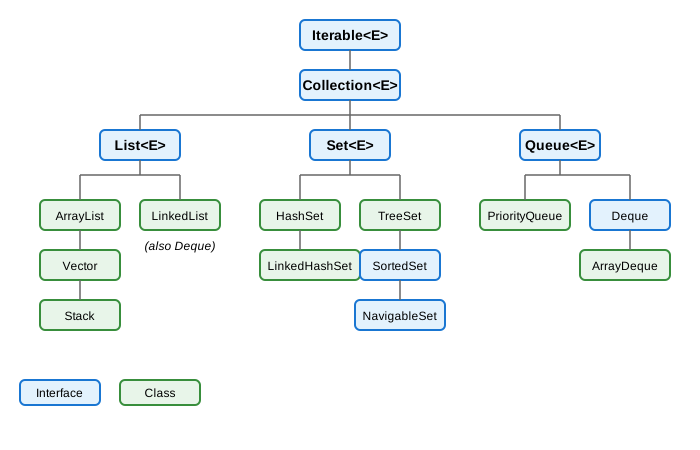
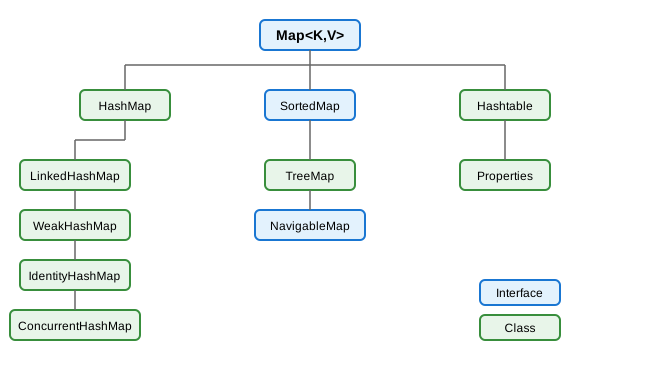
List Implementations
ArrayList
// Dynamic array - most commonly used
List<String> list = new ArrayList<>();
list.add("A");           // O(1) amortized
list.add(0, "B");        // O(n) - shifts elements
list.get(0);             // O(1) - random access
list.set(0, "C");        // O(1)
list.remove(0);          // O(n) - shifts elements
list.remove("A");        // O(n) - search + shift
list.contains("A");      // O(n)
list.size();             // O(1)

// Initialize with capacity to avoid resizing
List<String> sized = new ArrayList<>(1000);

// Create from existing collection
List<String> copy = new ArrayList<>(existingList);

// Immutable list (Java 9+)
List<String> immutable = List.of("A", "B", "C");
| Operation | Time Complexity |
|---|---|
| add(E) | O(1) amortized |
| add(index, E) | O(n) |
| get(index) | O(1) |
| set(index, E) | O(1) |
| remove(index) | O(n) |
| remove(Object) | O(n) |
| contains(Object) | O(n) |
| size() | O(1) |
Use When: Random access needed, mostly additions at end, infrequent insertions/deletions in middle.
LinkedList
// Doubly-linked list - also implements Deque
LinkedList<String> list = new LinkedList<>();
list.add("A");           // O(1)
list.addFirst("B");      // O(1)
list.addLast("C");       // O(1)
list.get(0);             // O(n) - must traverse
list.getFirst();         // O(1)
list.getLast();          // O(1)
list.remove(0);          // O(n) - traverse to index
list.removeFirst();      // O(1)
list.removeLast();       // O(1)

// As a Queue
list.offer("D");         // O(1) - add to end
list.poll();             // O(1) - remove from front
list.peek();             // O(1) - view front

// As a Stack
list.push("E");          // O(1) - add to front
list.pop();              // O(1) - remove from front
| Operation | Time Complexity |
|---|---|
| add(E) | O(1) |
| add(index, E) | O(n) |
| get(index) | O(n) |
| getFirst/getLast | O(1) |
| removeFirst/removeLast | O(1) |
| remove(index) | O(n) |
| contains(Object) | O(n) |
Use When: Frequent insertions/deletions at both ends, implementing queue/deque, iterator-based removal.
ArrayList vs LinkedList
| Aspect | ArrayList | LinkedList |
|---|---|---|
| Memory | Compact, contiguous | Higher (node overhead) |
| Random Access | O(1) | O(n) |
| Insert at End | O(1) amortized | O(1) |
| Insert at Start | O(n) | O(1) |
| Insert in Middle | O(n) | O(n)* |
| Cache Performance | Better (locality) | Worse (scattered) |
*LinkedList: O(1) for insert itself, but O(n) to find position
Rule of Thumb: Use ArrayList unless you need constant-time insertions at both ends.
Set Implementations
HashSet
// Hash table - fastest for add/remove/contains
Set<String> set = new HashSet<>();
set.add("A");            // O(1) average
set.remove("A");         // O(1) average
set.contains("A");       // O(1) average
set.size();              // O(1)

// No duplicates
set.add("A");
set.add("A");            // Returns false, size still 1

// No ordering guaranteed
for (String s : set) {
    // Order may vary between runs
}

// Initialize with capacity and load factor
Set<String> optimized = new HashSet<>(1000, 0.75f);
| Operation | Average | Worst Case |
|---|---|---|
| add(E) | O(1) | O(n) |
| remove(Object) | O(1) | O(n) |
| contains(Object) | O(1) | O(n) |
Use When: Fast lookups needed, order doesn't matter, no duplicates.
LinkedHashSet
// Hash table + linked list - maintains insertion order
Set<String> set = new LinkedHashSet<>();
set.add("C");
set.add("A");
set.add("B");

for (String s : set) {
    // Always: C, A, B (insertion order)
}
| Operation | Time Complexity |
|---|---|
| add(E) | O(1) |
| remove(Object) | O(1) |
| contains(Object) | O(1) |
| Iteration | O(n) in insertion order |
Use When: Need HashSet performance + predictable iteration order.
TreeSet
// Red-Black tree - sorted order
Set<String> set = new TreeSet<>();
set.add("C");
set.add("A");
set.add("B");

for (String s : set) {
    // Always: A, B, C (natural order)
}

// NavigableSet operations
TreeSet<Integer> nums = new TreeSet<>();
nums.addAll(List.of(1, 3, 5, 7, 9));

nums.first();            // 1
nums.last();             // 9
nums.lower(5);           // 3 (strictly less)
nums.floor(5);           // 5 (less or equal)
nums.higher(5);          // 7 (strictly greater)
nums.ceiling(5);         // 5 (greater or equal)
nums.headSet(5);         // [1, 3] (less than 5)
nums.tailSet(5);         // [5, 7, 9] (>= 5)
nums.subSet(3, 7);       // [3, 5] (>= 3, < 7)

// Custom comparator
Set<String> byLength = new TreeSet<>(Comparator.comparingInt(String::length));
| Operation | Time Complexity |
|---|---|
| add(E) | O(log n) |
| remove(Object) | O(log n) |
| contains(Object) | O(log n) |
| first/last | O(log n) |
Use When: Need sorted order, range queries, finding nearest elements.
Set Comparison
| Feature | HashSet | LinkedHashSet | TreeSet |
|---|---|---|---|
| Order | None | Insertion | Sorted |
| add/remove/contains | O(1) | O(1) | O(log n) |
| Null allowed | Yes (1) | Yes (1) | No* |
| Memory | Lowest | Medium | Highest |
*TreeSet allows null only if Comparator handles it
Queue Implementations
PriorityQueue
// Min-heap by default
PriorityQueue<Integer> minHeap = new PriorityQueue<>();
minHeap.offer(5);        // O(log n)
minHeap.offer(2);
minHeap.offer(8);
minHeap.peek();          // 2 (smallest) - O(1)
minHeap.poll();          // 2 (removes smallest) - O(log n)

// Max-heap
PriorityQueue<Integer> maxHeap = new PriorityQueue<>(Comparator.reverseOrder());
maxHeap.offer(5);
maxHeap.offer(2);
maxHeap.offer(8);
maxHeap.peek();          // 8 (largest)

// Custom objects
PriorityQueue<Task> taskQueue = new PriorityQueue<>(
    Comparator.comparingInt(Task::getPriority)
);
| Operation | Time Complexity |
|---|---|
| offer(E) | O(log n) |
| poll() | O(log n) |
| peek() | O(1) |
| remove(Object) | O(n) |
| contains(Object) | O(n) |
Use When: Processing elements by priority, finding min/max, top K problems.
ArrayDeque
// Resizable array deque - faster than LinkedList
Deque<String> deque = new ArrayDeque<>();

// As a Stack (LIFO)
deque.push("A");         // O(1)
deque.push("B");
deque.pop();             // "B" - O(1)
deque.peek();            // "A" - O(1)

// As a Queue (FIFO)
deque.offer("C");        // O(1) - add to end
deque.poll();            // "A" - O(1) - remove from front

// Double-ended operations
deque.addFirst("X");     // O(1)
deque.addLast("Y");      // O(1)
deque.removeFirst();     // O(1)
deque.removeLast();      // O(1)
| Operation | Time Complexity |
|---|---|
| push/pop | O(1) |
| offer/poll | O(1) |
| addFirst/addLast | O(1) |
| removeFirst/removeLast | O(1) |
| get(index) | Not supported |
Use When: Stack or queue needed, better performance than Stack/LinkedList.
Common Operations
Bulk Operations
List<String> list1 = new ArrayList<>(List.of("A", "B", "C"));
List<String> list2 = new ArrayList<>(List.of("B", "C", "D"));

// Union
Set<String> union = new HashSet<>(list1);
union.addAll(list2);  // [A, B, C, D]

// Intersection
Set<String> intersection = new HashSet<>(list1);
intersection.retainAll(list2);  // [B, C]

// Difference
Set<String> difference = new HashSet<>(list1);
difference.removeAll(list2);  // [A]

// Check containment
list1.containsAll(list2);  // false
Sorting
List<Integer> numbers = new ArrayList<>(List.of(3, 1, 4, 1, 5));

// Natural order
Collections.sort(numbers);  // [1, 1, 3, 4, 5]
numbers.sort(null);         // Same as above

// Custom comparator
numbers.sort(Comparator.reverseOrder());  // [5, 4, 3, 1, 1]

// Complex objects
List<Person> people = ...;
people.sort(Comparator.comparing(Person::getLastName)
    .thenComparing(Person::getFirstName)
    .thenComparingInt(Person::getAge));
Searching
List<Integer> sorted = List.of(1, 2, 3, 4, 5, 6, 7, 8, 9);

// Binary search (list must be sorted)
int index = Collections.binarySearch(sorted, 5);  // Returns index or (-(insertion point) - 1)

// Min/Max
int min = Collections.min(sorted);
int max = Collections.max(sorted);

// Custom comparator
Person youngest = Collections.min(people, Comparator.comparingInt(Person::getAge));
Shuffling and Rotating
List<Integer> list = new ArrayList<>(List.of(1, 2, 3, 4, 5));

Collections.shuffle(list);           // Random order
Collections.reverse(list);           // Reverse order
Collections.rotate(list, 2);         // [4, 5, 1, 2, 3]
Collections.swap(list, 0, 4);        // Swap positions
Collections.fill(list, 0);           // All zeros
Immutable Collections
// Java 9+ factory methods (truly immutable)
List<String> list = List.of("A", "B", "C");
Set<String> set = Set.of("A", "B", "C");
Map<String, Integer> map = Map.of("A", 1, "B", 2);

// These throw UnsupportedOperationException on modification
// list.add("D");  // Throws!

// Unmodifiable wrappers (view, can be modified through original)
List<String> original = new ArrayList<>(List.of("A", "B"));
List<String> unmodifiable = Collections.unmodifiableList(original);
original.add("C");  // Works, unmodifiable view now shows C

// Copy to immutable (Java 10+)
List<String> immutableCopy = List.copyOf(original);
Thread-Safe Collections
// Legacy synchronized collections
Vector<String> vector = new Vector<>();  // Don't use
Hashtable<String, Integer> hashtable = new Hashtable<>();  // Don't use

// Synchronized wrappers
List<String> syncList = Collections.synchronizedList(new ArrayList<>());
Set<String> syncSet = Collections.synchronizedSet(new HashSet<>());
Map<String, Integer> syncMap = Collections.synchronizedMap(new HashMap<>());

// Iteration still needs external sync
synchronized (syncList) {
    for (String s : syncList) {
        // Safe iteration
    }
}

// Concurrent collections (preferred)
ConcurrentHashMap<String, Integer> concurrentMap = new ConcurrentHashMap<>();
CopyOnWriteArrayList<String> cowList = new CopyOnWriteArrayList<>();
CopyOnWriteArraySet<String> cowSet = new CopyOnWriteArraySet<>();
ConcurrentLinkedQueue<String> concurrentQueue = new ConcurrentLinkedQueue<>();
BlockingQueue<String> blockingQueue = new LinkedBlockingQueue<>();
Big O Summary
| Collection | Add | Remove | Get | Contains | Notes |
|---|---|---|---|---|---|
| ArrayList | O(1)* | O(n) | O(1) | O(n) | *amortized, end |
| LinkedList | O(1) | O(1)** | O(n) | O(n) | **at known position |
| HashSet | O(1) | O(1) | - | O(1) | Average case |
| TreeSet | O(log n) | O(log n) | - | O(log n) | Sorted |
| HashMap | O(1) | O(1) | O(1) | O(1) | Average case |
| TreeMap | O(log n) | O(log n) | O(log n) | O(log n) | Sorted |
| PriorityQueue | O(log n) | O(log n) | O(1)*** | O(n) | ***peek only |
| ArrayDeque | O(1) | O(1) | - | O(n) | Ends only |
When to Use What
| Need | Use |
|---|---|
| Indexed access, variable size | ArrayList |
| Frequent add/remove at ends | ArrayDeque |
| Queue (FIFO) | ArrayDeque or LinkedList |
| Stack (LIFO) | ArrayDeque |
| Priority ordering | PriorityQueue |
| Unique elements, fast lookup | HashSet |
| Unique elements, sorted | TreeSet |
| Unique elements, insertion order | LinkedHashSet |
| Key-value pairs, fast lookup | HashMap |
| Key-value pairs, sorted | TreeMap |
| Key-value pairs, insertion order | LinkedHashMap |
| Thread-safe map | ConcurrentHashMap |
| Thread-safe list with many reads | CopyOnWriteArrayList |
Common Interview Questions
- ArrayList vs LinkedList?
- ArrayList: Better random access, cache-friendly, less memory
-
LinkedList: Better insert/remove at ends, implements Deque
-
HashSet vs TreeSet?
- HashSet: O(1) operations, no ordering
-
TreeSet: O(log n) operations, sorted, range queries
-
How does ArrayList resize?
-
When full, creates new array 1.5x size, copies elements
-
Why is HashMap iteration order unpredictable?
-
Elements stored by hash bucket, bucket order varies with size and hash distribution
-
What's the initial capacity and load factor of HashMap?
- Default capacity: 16, load factor: 0.75
- Resizes when size > capacity × load factor