Fast & Slow Pointers (Floyd's Cycle Detection)
Overview
Use two pointers moving at different speeds to detect cycles, find middle elements, or solve linked list problems efficiently.
When to Use
- Cycle detection in linked list or array
- Finding middle of linked list
- Finding cycle start position
- Palindrome linked list
- Happy number problem
- Finding duplicate number
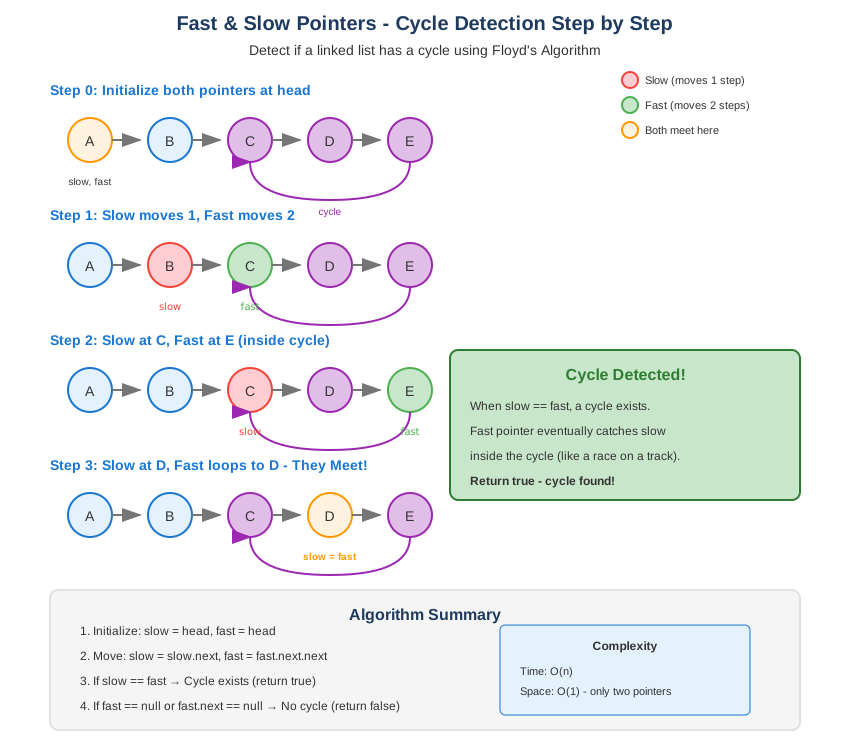
Key Concepts: - Without Cycle: Fast reaches end (null) before meeting slow - With Cycle: Fast eventually catches slow inside the cycle - Finding Middle: When fast reaches end, slow is at middle
Template Code
Detect Cycle in Linked List
public boolean hasCycle(ListNode head) {
    if (head == null || head.next == null) return false;

    ListNode slow = head;
    ListNode fast = head;

    while (fast != null && fast.next != null) {
        slow = slow.next;        // Move 1 step
        fast = fast.next.next;   // Move 2 steps

        if (slow == fast) {
            return true;  // Cycle detected
        }
    }
    return false;  // No cycle
}
Find Cycle Start (Entry Point)
public ListNode detectCycle(ListNode head) {
    if (head == null || head.next == null) return null;

    ListNode slow = head;
    ListNode fast = head;

    // Phase 1: Detect cycle
    while (fast != null && fast.next != null) {
        slow = slow.next;
        fast = fast.next.next;

        if (slow == fast) {
            // Phase 2: Find entry point
            ListNode entry = head;
            while (entry != slow) {
                entry = entry.next;
                slow = slow.next;
            }
            return entry;
        }
    }
    return null;
}
Find Middle of Linked List
public ListNode middleNode(ListNode head) {
    ListNode slow = head;
    ListNode fast = head;

    while (fast != null && fast.next != null) {
        slow = slow.next;
        fast = fast.next.next;
    }

    return slow;  // For even length, returns second middle
}

// For first middle in even length list:
public ListNode firstMiddle(ListNode head) {
    ListNode slow = head;
    ListNode fast = head;

    while (fast.next != null && fast.next.next != null) {
        slow = slow.next;
        fast = fast.next.next;
    }

    return slow;
}
Happy Number
public boolean isHappy(int n) {
    int slow = n;
    int fast = n;

    do {
        slow = sumOfSquares(slow);
        fast = sumOfSquares(sumOfSquares(fast));
    } while (slow != fast);

    return slow == 1;
}

private int sumOfSquares(int n) {
    int sum = 0;
    while (n > 0) {
        int digit = n % 10;
        sum += digit * digit;
        n /= 10;
    }
    return sum;
}
Find Duplicate Number (Floyd's Algorithm)
// Array where nums[i] ∈ [1, n], find the duplicate
public int findDuplicate(int[] nums) {
    // Treat array as linked list: i → nums[i]
    int slow = nums[0];
    int fast = nums[0];

    // Phase 1: Find intersection point
    do {
        slow = nums[slow];
        fast = nums[nums[fast]];
    } while (slow != fast);

    // Phase 2: Find cycle entrance (duplicate)
    slow = nums[0];
    while (slow != fast) {
        slow = nums[slow];
        fast = nums[fast];
    }

    return slow;
}
Palindrome Linked List
public boolean isPalindrome(ListNode head) {
    if (head == null || head.next == null) return true;

    // Find middle
    ListNode slow = head;
    ListNode fast = head;
    while (fast.next != null && fast.next.next != null) {
        slow = slow.next;
        fast = fast.next.next;
    }

    // Reverse second half
    ListNode secondHalf = reverseList(slow.next);

    // Compare halves
    ListNode p1 = head;
    ListNode p2 = secondHalf;
    boolean isPalin = true;

    while (p2 != null) {
        if (p1.val != p2.val) {
            isPalin = false;
            break;
        }
        p1 = p1.next;
        p2 = p2.next;
    }

    // Restore list (optional)
    slow.next = reverseList(secondHalf);

    return isPalin;
}

private ListNode reverseList(ListNode head) {
    ListNode prev = null;
    while (head != null) {
        ListNode next = head.next;
        head.next = prev;
        prev = head;
        head = next;
    }
    return prev;
}
Reorder List (L0→Ln→L1→Ln-1...)
public void reorderList(ListNode head) {
    if (head == null || head.next == null) return;

    // Find middle
    ListNode slow = head, fast = head;
    while (fast.next != null && fast.next.next != null) {
        slow = slow.next;
        fast = fast.next.next;
    }

    // Reverse second half
    ListNode second = reverseList(slow.next);
    slow.next = null;  // Cut first half

    // Merge alternating
    ListNode first = head;
    while (second != null) {
        ListNode temp1 = first.next;
        ListNode temp2 = second.next;

        first.next = second;
        second.next = temp1;

        first = temp1;
        second = temp2;
    }
}
Find Cycle Length
public int cycleLength(ListNode head) {
    ListNode slow = head, fast = head;

    while (fast != null && fast.next != null) {
        slow = slow.next;
        fast = fast.next.next;

        if (slow == fast) {
            // Count cycle length
            int length = 1;
            ListNode current = slow.next;
            while (current != slow) {
                length++;
                current = current.next;
            }
            return length;
        }
    }
    return 0;  // No cycle
}
Mathematical Proof (Cycle Detection)
Let:
- m = distance from head to cycle start
- k = distance from cycle start to meeting point
- L = cycle length

When they meet:
- Slow traveled: m + k
- Fast traveled: m + k + nL (n complete cycles)

Since fast = 2 × slow:
  m + k + nL = 2(m + k)
  nL = m + k
  m = nL - k

This means: starting from head and meeting point,
            both will meet at cycle start after m steps!
Time & Space Complexity
| Problem | Time | Space |
|---|---|---|
| Cycle detection | O(n) | O(1) |
| Find cycle start | O(n) | O(1) |
| Find middle | O(n) | O(1) |
| Happy number | O(log n) | O(1) |
| Find duplicate | O(n) | O(1) |
| Palindrome list | O(n) | O(1) |
Common Interview Questions
- Linked List Cycle - Detect if cycle exists
- Linked List Cycle II - Find cycle start node
- Middle of Linked List - Return middle node
- Happy Number - Sum of squares cycle
- Find the Duplicate Number - O(1) space solution
- Palindrome Linked List - Check if palindrome
- Reorder List - Interleave first and second half
- Remove Nth Node From End - Fast pointer n steps ahead
- Intersection of Two Linked Lists - Find merge point
- Circular Array Loop - Detect cycle in array
Tips & Tricks
- Fast moves 2x slow is most common, but ratio can vary
- To find Nth from end: advance fast N steps, then move both
- For middle: when fast reaches end, slow is at middle
- Cycle start finding: both pointers move 1 step in phase 2
- Works for arrays too when elements form implicit links
- Always handle edge cases: null, single node, no cycle