Union-Find (Disjoint Set Union) Pattern
Overview
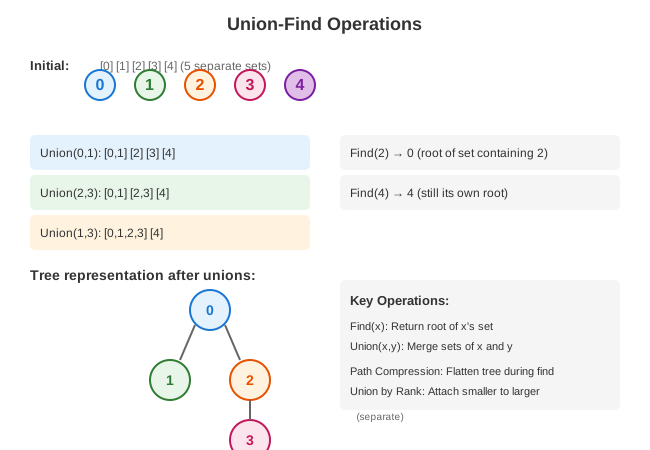
Data structure to track elements partitioned into disjoint sets. Supports near-constant time union and find operations with path compression and union by rank.
When to Use
- Finding connected components
- Detecting cycles in undirected graph
- Kruskal's minimum spanning tree
- Grouping/clustering problems
- Dynamic connectivity
- Checking if nodes are in same group
Template Code
Basic Union-Find with Optimizations
class UnionFind {
    private int[] parent;
    private int[] rank;
    private int count;  // Number of components

    public UnionFind(int n) {
        parent = new int[n];
        rank = new int[n];
        count = n;

        for (int i = 0; i < n; i++) {
            parent[i] = i;
            rank[i] = 0;
        }
    }

    // Find with path compression
    public int find(int x) {
        if (parent[x] != x) {
            parent[x] = find(parent[x]);  // Path compression
        }
        return parent[x];
    }

    // Union by rank
    public boolean union(int x, int y) {
        int rootX = find(x);
        int rootY = find(y);

        if (rootX == rootY) {
            return false;  // Already connected
        }

        // Attach smaller tree under larger tree
        if (rank[rootX] < rank[rootY]) {
            parent[rootX] = rootY;
        } else if (rank[rootX] > rank[rootY]) {
            parent[rootY] = rootX;
        } else {
            parent[rootY] = rootX;
            rank[rootX]++;
        }

        count--;
        return true;
    }

    public boolean connected(int x, int y) {
        return find(x) == find(y);
    }

    public int getCount() {
        return count;
    }
}
Number of Connected Components
public int countComponents(int n, int[][] edges) {
    UnionFind uf = new UnionFind(n);

    for (int[] edge : edges) {
        uf.union(edge[0], edge[1]);
    }

    return uf.getCount();
}
Number of Islands (Union-Find Approach)
public int numIslands(char[][] grid) {
    if (grid == null || grid.length == 0) return 0;

    int m = grid.length, n = grid[0].length;
    UnionFind uf = new UnionFind(m * n);
    int water = 0;

    int[][] directions = {{0,1}, {1,0}};

    for (int i = 0; i < m; i++) {
        for (int j = 0; j < n; j++) {
            if (grid[i][j] == '0') {
                water++;
            } else {
                for (int[] dir : directions) {
                    int ni = i + dir[0], nj = j + dir[1];
                    if (ni < m && nj < n && grid[ni][nj] == '1') {
                        uf.union(i * n + j, ni * n + nj);
                    }
                }
            }
        }
    }

    return uf.getCount() - water;
}
Graph Valid Tree
public boolean validTree(int n, int[][] edges) {
    // Tree: n nodes, n-1 edges, connected, no cycles
    if (edges.length != n - 1) return false;

    UnionFind uf = new UnionFind(n);

    for (int[] edge : edges) {
        // If already connected, adding edge creates cycle
        if (!uf.union(edge[0], edge[1])) {
            return false;
        }
    }

    return uf.getCount() == 1;  // Must be connected
}
Redundant Connection (Find Cycle Edge)
public int[] findRedundantConnection(int[][] edges) {
    int n = edges.length;
    UnionFind uf = new UnionFind(n + 1);  // 1-indexed

    for (int[] edge : edges) {
        if (!uf.union(edge[0], edge[1])) {
            return edge;  // This edge creates cycle
        }
    }

    return new int[0];
}
Accounts Merge
public List<List<String>> accountsMerge(List<List<String>> accounts) {
    UnionFind uf = new UnionFind(accounts.size());
    Map<String, Integer> emailToIndex = new HashMap<>();

    // Union accounts with same email
    for (int i = 0; i < accounts.size(); i++) {
        for (int j = 1; j < accounts.get(i).size(); j++) {
            String email = accounts.get(i).get(j);

            if (emailToIndex.containsKey(email)) {
                uf.union(i, emailToIndex.get(email));
            } else {
                emailToIndex.put(email, i);
            }
        }
    }

    // Group emails by root account
    Map<Integer, TreeSet<String>> rootToEmails = new HashMap<>();
    for (int i = 0; i < accounts.size(); i++) {
        int root = uf.find(i);
        rootToEmails.putIfAbsent(root, new TreeSet<>());

        for (int j = 1; j < accounts.get(i).size(); j++) {
            rootToEmails.get(root).add(accounts.get(i).get(j));
        }
    }

    // Build result
    List<List<String>> result = new ArrayList<>();
    for (int root : rootToEmails.keySet()) {
        List<String> account = new ArrayList<>();
        account.add(accounts.get(root).get(0));  // Name
        account.addAll(rootToEmails.get(root));  // Sorted emails
        result.add(account);
    }

    return result;
}
Longest Consecutive Sequence
public int longestConsecutive(int[] nums) {
    if (nums.length == 0) return 0;

    Map<Integer, Integer> numToIndex = new HashMap<>();
    UnionFind uf = new UnionFind(nums.length);

    for (int i = 0; i < nums.length; i++) {
        if (numToIndex.containsKey(nums[i])) continue;  // Skip duplicates

        numToIndex.put(nums[i], i);

        if (numToIndex.containsKey(nums[i] - 1)) {
            uf.union(i, numToIndex.get(nums[i] - 1));
        }
        if (numToIndex.containsKey(nums[i] + 1)) {
            uf.union(i, numToIndex.get(nums[i] + 1));
        }
    }

    // Count elements in each component
    Map<Integer, Integer> rootToSize = new HashMap<>();
    int maxLen = 0;

    for (int i = 0; i < nums.length; i++) {
        if (!numToIndex.containsKey(nums[i])) continue;
        int root = uf.find(i);
        int size = rootToSize.getOrDefault(root, 0) + 1;
        rootToSize.put(root, size);
        maxLen = Math.max(maxLen, size);
    }

    return maxLen;
}
Union-Find with Size (for Largest Component)
class UnionFindWithSize {
    private int[] parent;
    private int[] size;

    public UnionFindWithSize(int n) {
        parent = new int[n];
        size = new int[n];
        for (int i = 0; i < n; i++) {
            parent[i] = i;
            size[i] = 1;
        }
    }

    public int find(int x) {
        if (parent[x] != x) {
            parent[x] = find(parent[x]);
        }
        return parent[x];
    }

    public void union(int x, int y) {
        int rootX = find(x);
        int rootY = find(y);

        if (rootX != rootY) {
            // Union by size
            if (size[rootX] < size[rootY]) {
                parent[rootX] = rootY;
                size[rootY] += size[rootX];
            } else {
                parent[rootY] = rootX;
                size[rootX] += size[rootY];
            }
        }
    }

    public int getSize(int x) {
        return size[find(x)];
    }
}
Earliest Time When All Become Friends
public int earliestAcq(int[][] logs, int n) {
    // Sort by timestamp
    Arrays.sort(logs, (a, b) -> a[0] - b[0]);

    UnionFind uf = new UnionFind(n);

    for (int[] log : logs) {
        uf.union(log[1], log[2]);
        if (uf.getCount() == 1) {
            return log[0];
        }
    }

    return -1;
}
Time & Space Complexity
| Operation | Time (with optimizations) | Amortized |
|---|---|---|
| Find | O(α(n)) | Nearly O(1) |
| Union | O(α(n)) | Nearly O(1) |
| Building | O(n) | O(n) |
Where α(n) is the inverse Ackermann function, effectively constant.
Common Interview Questions
- Number of Connected Components - Count disjoint sets
- Number of Islands - Grid connectivity
- Graph Valid Tree - Check n-1 edges, no cycle, connected
- Redundant Connection - Find edge that creates cycle
- Accounts Merge - Merge by shared emails
- Longest Consecutive Sequence - Union adjacent numbers
- Friend Circles - Count friend groups
- Sentence Similarity II - Transitive word similarity
- Smallest String With Swaps - Group swappable indices
- Satisfiability of Equality Equations - Process == before !=
- Regions Cut By Slashes - Grid subdivision
- Most Stones Removed - Max removable (n - components)
Tips & Tricks
- Always use path compression in find()
- Union by rank or size for balanced trees
- Initialize parent[i] = i
- Check if already connected before union for cycle detection
- Track component count for "number of groups" problems
- Can track additional info: size, min, max per component
- For 2D grids, use
i * cols + jas linear index