Greedy Algorithm Pattern
Overview
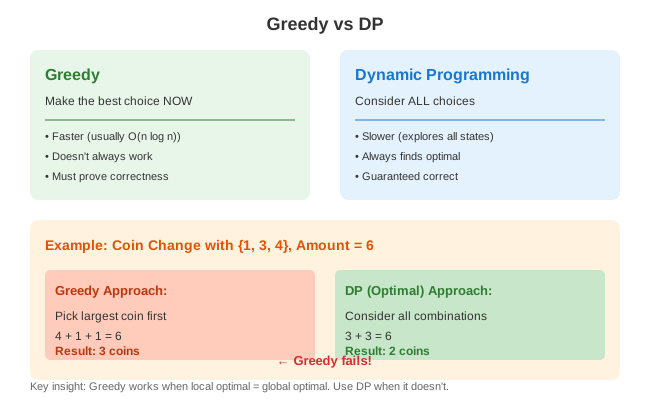
Make locally optimal choices at each step hoping to find a global optimum. Works when local choices don't compromise future options (greedy-choice property) and optimal substructure exists.
When to Use
- Interval scheduling/selection
- Huffman coding
- Minimum spanning tree
- Activity selection
- Task scheduling
- Coin change (specific denominations)
- String reconstruction
Template Code
Interval Scheduling (Max Non-overlapping)
public int maxNonOverlapping(int[][] intervals) {
    // Sort by end time (greedy: finish earliest)
    Arrays.sort(intervals, (a, b) -> a[1] - b[1]);

    int count = 0;
    int lastEnd = Integer.MIN_VALUE;

    for (int[] interval : intervals) {
        if (interval[0] >= lastEnd) {
            count++;
            lastEnd = interval[1];
        }
    }

    return count;
}
Jump Game
public boolean canJump(int[] nums) {
    int maxReach = 0;

    for (int i = 0; i < nums.length; i++) {
        if (i > maxReach) return false;
        maxReach = Math.max(maxReach, i + nums[i]);
    }

    return true;
}
Jump Game II (Minimum Jumps)
public int jump(int[] nums) {
    int jumps = 0;
    int currentEnd = 0;
    int farthest = 0;

    for (int i = 0; i < nums.length - 1; i++) {
        farthest = Math.max(farthest, i + nums[i]);

        if (i == currentEnd) {
            jumps++;
            currentEnd = farthest;
        }
    }

    return jumps;
}
Gas Station
public int canCompleteCircuit(int[] gas, int[] cost) {
    int totalGas = 0, totalCost = 0;
    int tank = 0, start = 0;

    for (int i = 0; i < gas.length; i++) {
        totalGas += gas[i];
        totalCost += cost[i];
        tank += gas[i] - cost[i];

        if (tank < 0) {
            // Can't reach i+1 from current start
            start = i + 1;
            tank = 0;
        }
    }

    return totalGas >= totalCost ? start : -1;
}
Best Time to Buy and Sell Stock II
public int maxProfit(int[] prices) {
    int profit = 0;

    for (int i = 1; i < prices.length; i++) {
        if (prices[i] > prices[i - 1]) {
            profit += prices[i] - prices[i - 1];
        }
    }

    return profit;
}
Partition Labels
public List<Integer> partitionLabels(String s) {
    int[] lastIndex = new int[26];

    // Find last occurrence of each character
    for (int i = 0; i < s.length(); i++) {
        lastIndex[s.charAt(i) - 'a'] = i;
    }

    List<Integer> result = new ArrayList<>();
    int start = 0, end = 0;

    for (int i = 0; i < s.length(); i++) {
        end = Math.max(end, lastIndex[s.charAt(i) - 'a']);

        if (i == end) {
            result.add(end - start + 1);
            start = i + 1;
        }
    }

    return result;
}
Task Scheduler
public int leastInterval(char[] tasks, int n) {
    int[] freq = new int[26];
    int maxFreq = 0;
    int maxCount = 0;

    for (char task : tasks) {
        freq[task - 'A']++;
        if (freq[task - 'A'] > maxFreq) {
            maxFreq = freq[task - 'A'];
            maxCount = 1;
        } else if (freq[task - 'A'] == maxFreq) {
            maxCount++;
        }
    }

    // (maxFreq - 1) complete cycles + last partial cycle
    int intervals = (maxFreq - 1) * (n + 1) + maxCount;

    return Math.max(intervals, tasks.length);
}
Candy Distribution
public int candy(int[] ratings) {
    int n = ratings.length;
    int[] candies = new int[n];
    Arrays.fill(candies, 1);

    // Left to right: if higher rating than left, give more
    for (int i = 1; i < n; i++) {
        if (ratings[i] > ratings[i - 1]) {
            candies[i] = candies[i - 1] + 1;
        }
    }

    // Right to left: if higher rating than right, give more
    for (int i = n - 2; i >= 0; i--) {
        if (ratings[i] > ratings[i + 1]) {
            candies[i] = Math.max(candies[i], candies[i + 1] + 1);
        }
    }

    int total = 0;
    for (int c : candies) {
        total += c;
    }
    return total;
}
Minimum Platforms (Train Schedule)
public int findPlatform(int[] arrivals, int[] departures) {
    Arrays.sort(arrivals);
    Arrays.sort(departures);

    int platforms = 0, maxPlatforms = 0;
    int i = 0, j = 0;

    while (i < arrivals.length && j < departures.length) {
        if (arrivals[i] <= departures[j]) {
            platforms++;
            i++;
        } else {
            platforms--;
            j++;
        }
        maxPlatforms = Math.max(maxPlatforms, platforms);
    }

    return maxPlatforms;
}
Assign Cookies
public int findContentChildren(int[] greed, int[] cookies) {
    Arrays.sort(greed);
    Arrays.sort(cookies);

    int child = 0, cookie = 0;

    while (child < greed.length && cookie < cookies.length) {
        if (cookies[cookie] >= greed[child]) {
            child++;
        }
        cookie++;
    }

    return child;
}
Boats to Save People
public int numRescueBoats(int[] people, int limit) {
    Arrays.sort(people);
    int boats = 0;
    int left = 0, right = people.length - 1;

    while (left <= right) {
        if (people[left] + people[right] <= limit) {
            left++;
        }
        right--;
        boats++;
    }

    return boats;
}
Fractional Knapsack
public double fractionalKnapsack(int[] weights, int[] values, int capacity) {
    int n = weights.length;
    double[][] items = new double[n][2];

    for (int i = 0; i < n; i++) {
        items[i][0] = weights[i];
        items[i][1] = (double) values[i] / weights[i];  // Value per unit
    }

    // Sort by value per unit (descending)
    Arrays.sort(items, (a, b) -> Double.compare(b[1], a[1]));

    double totalValue = 0;
    double remainingCapacity = capacity;

    for (double[] item : items) {
        if (remainingCapacity >= item[0]) {
            // Take whole item
            totalValue += item[0] * item[1];
            remainingCapacity -= item[0];
        } else {
            // Take fraction
            totalValue += remainingCapacity * item[1];
            break;
        }
    }

    return totalValue;
}
Reorganize String
public String reorganizeString(String s) {
    int[] freq = new int[26];
    for (char c : s.toCharArray()) {
        freq[c - 'a']++;
    }

    PriorityQueue<int[]> maxHeap = new PriorityQueue<>((a, b) -> b[1] - a[1]);
    for (int i = 0; i < 26; i++) {
        if (freq[i] > 0) {
            maxHeap.offer(new int[]{i, freq[i]});
        }
    }

    StringBuilder result = new StringBuilder();
    int[] prev = null;

    while (!maxHeap.isEmpty()) {
        int[] curr = maxHeap.poll();
        result.append((char) (curr[0] + 'a'));
        curr[1]--;

        if (prev != null && prev[1] > 0) {
            maxHeap.offer(prev);
        }

        prev = curr;
    }

    return result.length() == s.length() ? result.toString() : "";
}
Time & Space Complexity
| Problem | Time | Space |
|---|---|---|
| Interval scheduling | O(n log n) | O(1) |
| Jump game | O(n) | O(1) |
| Gas station | O(n) | O(1) |
| Task scheduler | O(n) | O(1) |
| Candy | O(n) | O(n) |
Common Interview Questions
- Jump Game - Can reach last index?
- Jump Game II - Min jumps to reach end
- Gas Station - Starting point for circular trip
- Best Time to Buy and Sell II - Max profit, multiple transactions
- Partition Labels - Min partitions, each char in one part
- Task Scheduler - Min time with cooldown
- Candy - Min candies with rating constraints
- Meeting Rooms II - Min rooms needed
- Non-overlapping Intervals - Min removals
- Minimum Number of Arrows - Burst balloons
- Assign Cookies - Max satisfied children
- Boats to Save People - Min boats needed
- Reorganize String - No adjacent same chars
- Queue Reconstruction by Height - Rebuild queue
Tips & Tricks
- Sorting is often the first step (by end time, value/weight, etc.)
- Prove greedy works by showing optimal substructure
- Common greedy strategies:
- Select earliest finish time
- Select smallest/largest first
- Select highest value-to-weight ratio
- Two-pointer often pairs with greedy after sorting
- If greedy fails, consider DP
- Counter-examples help identify when greedy doesn't work