Fundamentals
What is a Distributed System?
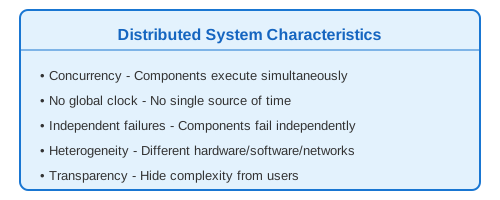
A collection of independent computers that appears to users as a single coherent system.
CAP Theorem
You can only have 2 of 3 guarantees at the same time during a network partition.
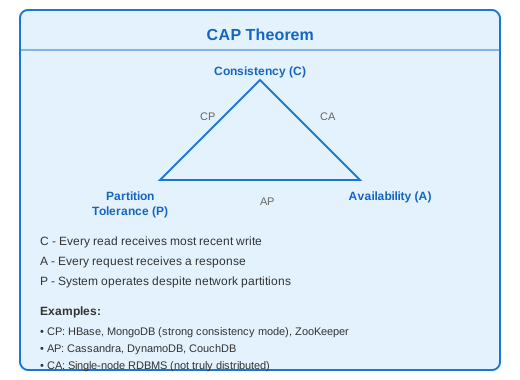
Reality: Network partitions WILL happen, so you're really choosing between CP and AP.
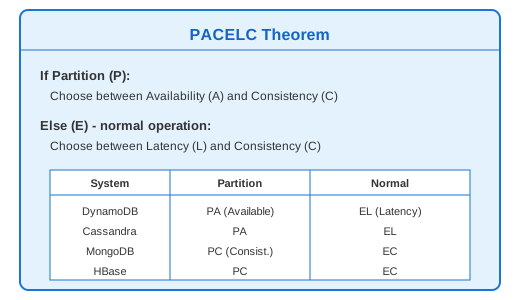
PACELC Theorem
Extension of CAP: What happens when there's NO partition?
Consistency Models
Strong Consistency
Every read returns the most recent write. Appears as if there's only one copy of data.
// Strong consistency example
// After write completes, ALL readers see new value
client1.write("x", 10);  // Completes
client2.read("x");       // Always returns 10
client3.read("x");       // Always returns 10
Eventual Consistency
Given enough time without updates, all replicas converge to same value.
// Eventual consistency example
client1.write("x", 10);  // Returns immediately
client2.read("x");       // Might return old value
// ... time passes ...
client2.read("x");       // Eventually returns 10
Causal Consistency
Operations that are causally related are seen in same order by all nodes.
// Causal consistency
client1.write("x", 1);                    // A
client1.write("y", 2);                    // B (causally after A)
// All nodes see A before B

client2.write("z", 3);                    // C (concurrent with A, B)
// C can be seen in any order relative to A, B
Read-Your-Writes Consistency
A process always sees its own writes.
Monotonic Reads
If a process reads value v, subsequent reads won't return older values.
// Monotonic reads
client1.read("x");  // Returns version 5
client1.read("x");  // Returns version >= 5
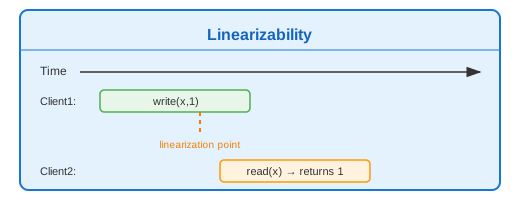
Linearizability
Strongest consistency. Operations appear instantaneous at some point between invocation and response.
Consensus Algorithms
Why Consensus?
Distributed nodes must agree on: - Leader election - Transaction commit - State machine replication - Configuration changes
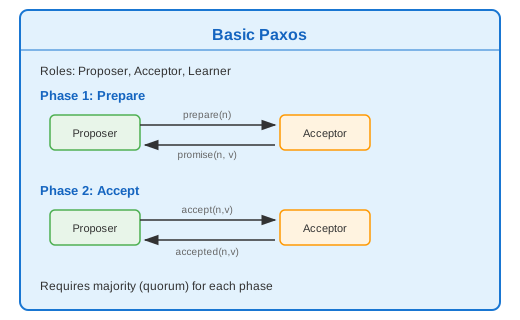
Paxos
Raft (Easier to Understand)
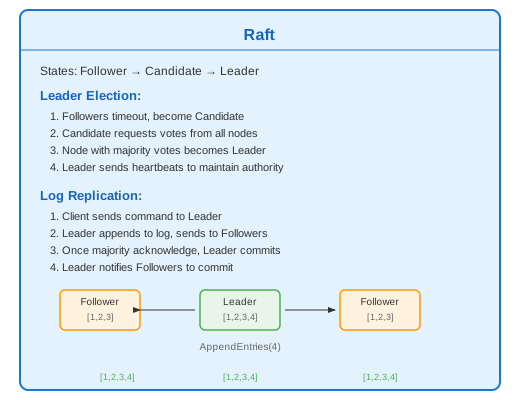
Raft Guarantees: - Election Safety: At most one leader per term - Leader Append-Only: Leader never overwrites/deletes entries - Log Matching: If two logs have entry with same index/term, all preceding entries are identical - Leader Completeness: Committed entry will be present in all future leaders' logs
Vector Clocks
Track causality in distributed systems without synchronized clocks.
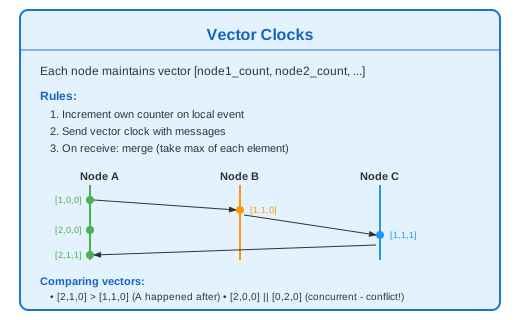
Use cases: Conflict detection in eventually consistent systems (DynamoDB, Riak)
Replication Strategies
Single-Leader (Primary-Backup)
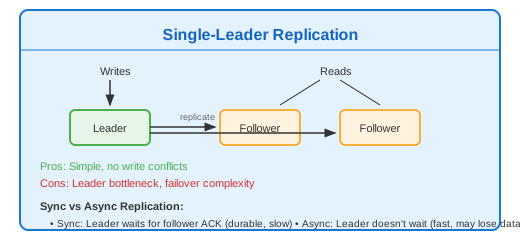
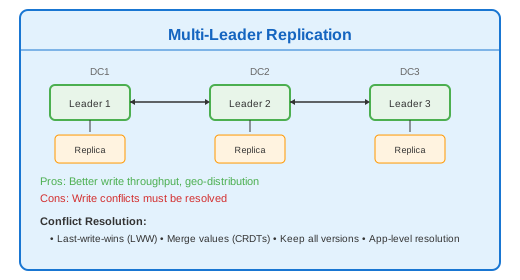
Multi-Leader
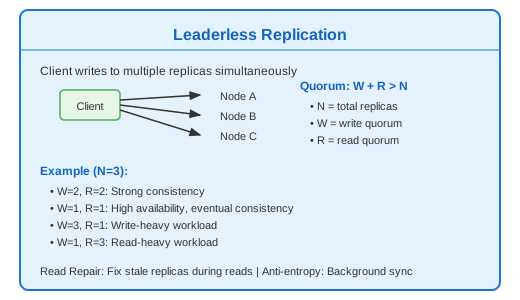
Leaderless (Dynamo-style)
Partitioning (Sharding)
Hash Partitioning
// Simple hash partitioning
int partition = hash(key) % numPartitions;

// Problem: Adding/removing nodes reshuffles most keys
// N=3: hash(key) % 3 = 1
// N=4: hash(key) % 4 = 2  // Different partition!
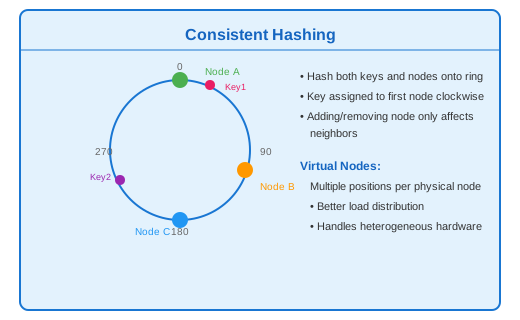
Consistent Hashing
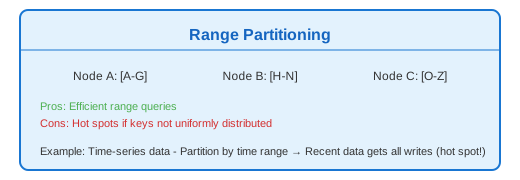
Range Partitioning
Failure Detection
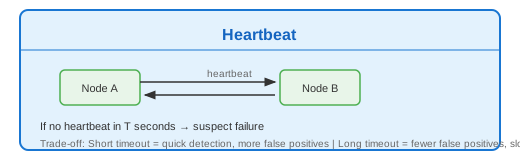
Heartbeat
Phi Accrual Failure Detector
Outputs suspicion level (φ) instead of binary alive/dead.
φ = -log10(P(heartbeat_delay > t))

• φ = 1: 10% probability node is alive
• φ = 2: 1% probability node is alive
• φ = 3: 0.1% probability node is alive

Application decides threshold based on needs.
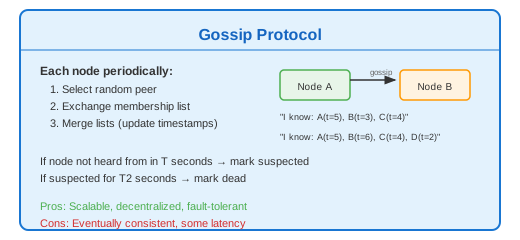
Gossip Protocol
Distributed Transactions
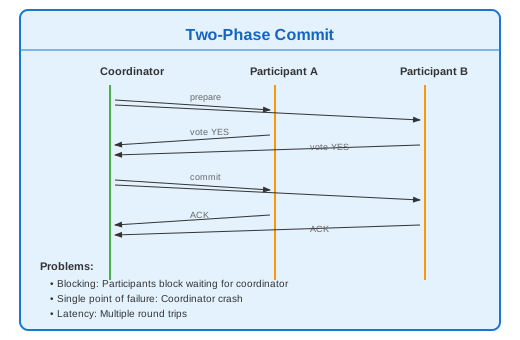
Two-Phase Commit (2PC)
Three-Phase Commit (3PC)
Adds "pre-commit" phase to reduce blocking, but still not partition-tolerant.
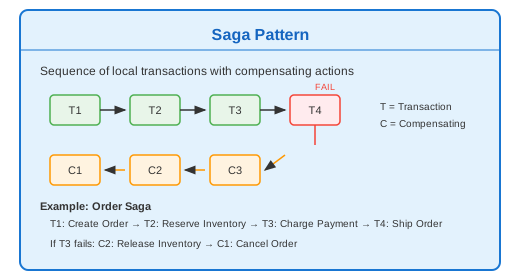
Saga Pattern
Common Interview Questions
- Explain CAP theorem with examples
- Network partitions happen; choose CP (consistency) or AP (availability)
-
Examples: ZooKeeper (CP), Cassandra (AP)
-
How does Raft leader election work?
- Followers timeout, become candidates
- Request votes, majority wins
-
Leader sends heartbeats
-
Difference between strong and eventual consistency?
- Strong: All reads see latest write
-
Eventual: Given time, all replicas converge
-
How does consistent hashing help scaling?
- Only K/N keys move when adding/removing nodes
-
Virtual nodes improve distribution
-
2PC vs Saga pattern?
- 2PC: ACID, blocking, coordinator failure issues
- Saga: Eventually consistent, compensating transactions