Scalability Patterns
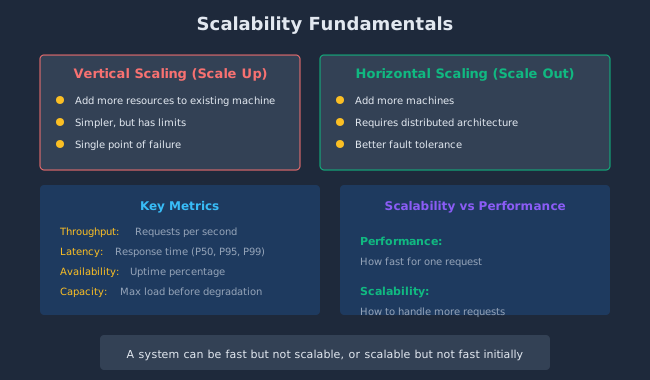
Scalability Overview
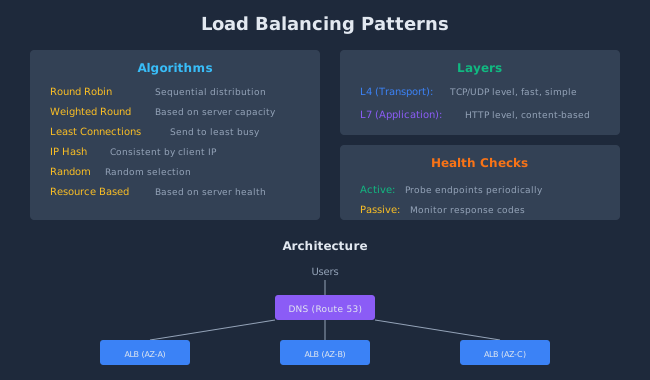
Load Balancing
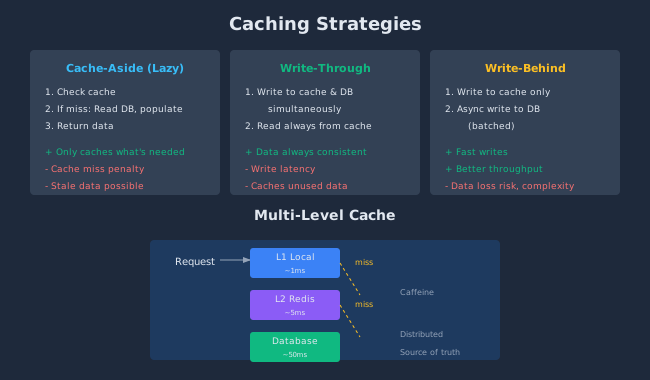
Caching Patterns
Cache Implementation
@Service
public class UserService {

    private final UserRepository userRepository;
    private final RedisTemplate<String, User> redisTemplate;
    private static final Duration CACHE_TTL = Duration.ofMinutes(15);

    // Cache-Aside pattern
    public User getUser(Long userId) {
        String cacheKey = "user:" + userId;

        // Check cache first
        User cached = redisTemplate.opsForValue().get(cacheKey);
        if (cached != null) {
            return cached;
        }

        // Cache miss - fetch from DB
        User user = userRepository.findById(userId)
            .orElseThrow(() -> new UserNotFoundException(userId));

        // Populate cache
        redisTemplate.opsForValue().set(cacheKey, user, CACHE_TTL);

        return user;
    }

    // Write-Through pattern
    public User updateUser(Long userId, UserUpdateRequest request) {
        User user = userRepository.findById(userId)
            .orElseThrow(() -> new UserNotFoundException(userId));

        user.setName(request.getName());
        user.setEmail(request.getEmail());

        // Write to DB
        user = userRepository.save(user);

        // Write to cache
        String cacheKey = "user:" + userId;
        redisTemplate.opsForValue().set(cacheKey, user, CACHE_TTL);

        return user;
    }

    // Cache invalidation
    public void deleteUser(Long userId) {
        userRepository.deleteById(userId);
        redisTemplate.delete("user:" + userId);
    }
}
Multi-Level Caching
The caching strategies diagram above shows the multi-level cache architecture with L1 (local), L2 (distributed), and database layers.
@Service
public class MultiLevelCacheService<K, V> {

    private final Cache<K, V> localCache;  // Caffeine
    private final RedisTemplate<K, V> redisTemplate;
    private final Duration localTtl = Duration.ofMinutes(5);
    private final Duration redisTtl = Duration.ofMinutes(30);

    public MultiLevelCacheService() {
        this.localCache = Caffeine.newBuilder()
            .maximumSize(10_000)
            .expireAfterWrite(localTtl)
            .build();
    }

    public V get(K key, Function<K, V> loader) {
        // L1: Check local cache
        V value = localCache.getIfPresent(key);
        if (value != null) {
            return value;
        }

        // L2: Check Redis
        value = redisTemplate.opsForValue().get(key);
        if (value != null) {
            localCache.put(key, value);
            return value;
        }

        // Load from source
        value = loader.apply(key);
        if (value != null) {
            put(key, value);
        }

        return value;
    }

    public void put(K key, V value) {
        localCache.put(key, value);
        redisTemplate.opsForValue().set(key, value, redisTtl);
    }

    public void invalidate(K key) {
        localCache.invalidate(key);
        redisTemplate.delete(key);
        // Publish invalidation event for other instances
        redisTemplate.convertAndSend("cache-invalidation", key.toString());
    }
}
Database Scaling
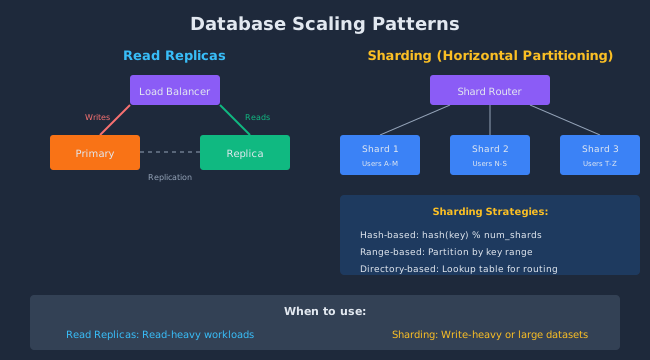
Read/Write Splitting
@Configuration
public class DataSourceConfig {

    @Bean
    @Primary
    public DataSource routingDataSource(
            @Qualifier("writerDataSource") DataSource writer,
            @Qualifier("readerDataSource") DataSource reader) {

        Map<Object, Object> targetDataSources = new HashMap<>();
        targetDataSources.put(DataSourceType.WRITER, writer);
        targetDataSources.put(DataSourceType.READER, reader);

        RoutingDataSource routingDataSource = new RoutingDataSource();
        routingDataSource.setTargetDataSources(targetDataSources);
        routingDataSource.setDefaultTargetDataSource(writer);

        return routingDataSource;
    }
}

public class RoutingDataSource extends AbstractRoutingDataSource {

    @Override
    protected Object determineCurrentLookupKey() {
        return DataSourceContextHolder.getDataSourceType();
    }
}

// Aspect for automatic routing
@Aspect
@Component
public class ReadOnlyRoutingAspect {

    @Around("@annotation(org.springframework.transaction.annotation.Transactional)")
    public Object route(ProceedingJoinPoint joinPoint) throws Throwable {
        Transactional transactional = getTransactionalAnnotation(joinPoint);

        if (transactional != null && transactional.readOnly()) {
            DataSourceContextHolder.setDataSourceType(DataSourceType.READER);
        } else {
            DataSourceContextHolder.setDataSourceType(DataSourceType.WRITER);
        }

        try {
            return joinPoint.proceed();
        } finally {
            DataSourceContextHolder.clear();
        }
    }
}
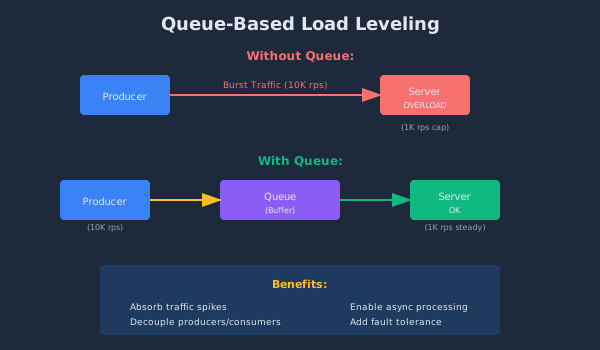
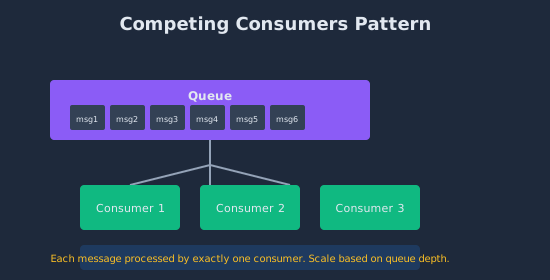
Message Queue Scaling
Connection Pooling
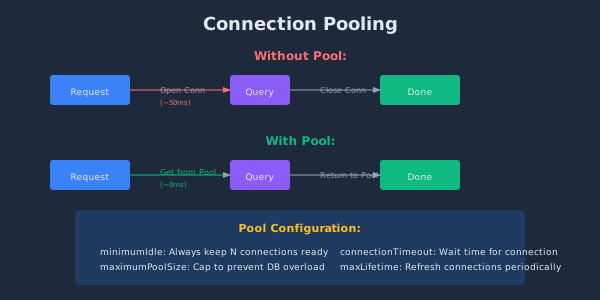
# HikariCP Configuration
spring:
  datasource:
    hikari:
      minimum-idle: 10
      maximum-pool-size: 50
      connection-timeout: 20000    # 20 seconds
      idle-timeout: 300000         # 5 minutes
      max-lifetime: 1200000        # 20 minutes
      pool-name: MyAppPool

# Sizing formula:
# connections = (core_count * 2) + effective_spindle_count
# For SSD with 4 cores: (4 * 2) + 1 = 9 connections minimum
Rate Limiting
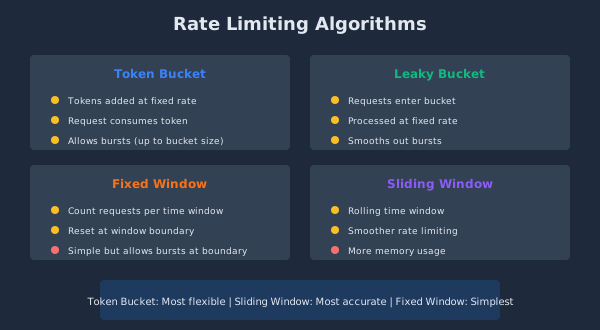
Rate Limiter Implementation
@Component
public class RedisRateLimiter {

    private final RedisTemplate<String, String> redisTemplate;
    private final int maxRequests;
    private final Duration window;

    // Sliding window rate limiter using Redis
    public boolean isAllowed(String key) {
        String redisKey = "ratelimit:" + key;
        long now = System.currentTimeMillis();
        long windowStart = now - window.toMillis();

        // Lua script for atomic operation
        String script = """
            -- Remove old entries
            redis.call('ZREMRANGEBYSCORE', KEYS[1], '-inf', ARGV[1])
            -- Count current entries
            local count = redis.call('ZCARD', KEYS[1])
            if count < tonumber(ARGV[2]) then
                -- Add current request
                redis.call('ZADD', KEYS[1], ARGV[3], ARGV[3])
                redis.call('EXPIRE', KEYS[1], ARGV[4])
                return 1
            end
            return 0
            """;

        Long result = redisTemplate.execute(
            new DefaultRedisScript<>(script, Long.class),
            List.of(redisKey),
            String.valueOf(windowStart),
            String.valueOf(maxRequests),
            String.valueOf(now),
            String.valueOf(window.getSeconds())
        );

        return result != null && result == 1;
    }
}

// Annotation-based rate limiting
@Target(ElementType.METHOD)
@Retention(RetentionPolicy.RUNTIME)
public @interface RateLimit {
    int requests() default 100;
    int seconds() default 60;
}

@Aspect
@Component
public class RateLimitAspect {

    @Autowired
    private RedisRateLimiter rateLimiter;

    @Around("@annotation(rateLimit)")
    public Object checkRateLimit(ProceedingJoinPoint joinPoint,
                                  RateLimit rateLimit) throws Throwable {
        String key = extractKey(joinPoint);

        if (!rateLimiter.isAllowed(key)) {
            throw new RateLimitExceededException("Rate limit exceeded");
        }

        return joinPoint.proceed();
    }
}
Auto-Scaling Patterns
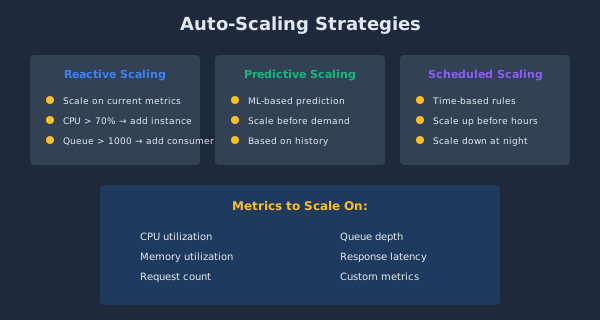
# Kubernetes HPA
apiVersion: autoscaling/v2
kind: HorizontalPodAutoscaler
metadata:
  name: myapp-hpa
spec:
  scaleTargetRef:
    apiVersion: apps/v1
    kind: Deployment
    name: myapp
  minReplicas: 2
  maxReplicas: 20
  metrics:
    - type: Resource
      resource:
        name: cpu
        target:
          type: Utilization
          averageUtilization: 70
    - type: Resource
      resource:
        name: memory
        target:
          type: Utilization
          averageUtilization: 80
    - type: Pods
      pods:
        metric:
          name: http_requests_per_second
        target:
          type: AverageValue
          averageValue: 1000
  behavior:
    scaleDown:
      stabilizationWindowSeconds: 300
      policies:
        - type: Percent
          value: 10
          periodSeconds: 60
    scaleUp:
      stabilizationWindowSeconds: 0
      policies:
        - type: Percent
          value: 100
          periodSeconds: 15
CDN & Edge Computing
Common Interview Questions
- How to scale a read-heavy application?
- Add read replicas
- Implement caching (Redis, CDN)
- Use async processing
-
Consider CQRS
-
How to handle thundering herd?
- Cache stampede protection
- Request coalescing
- Probabilistic early expiration
-
Circuit breakers
-
Vertical vs horizontal scaling?
- Vertical: Simpler, has limits, SPOF
-
Horizontal: Complex, unlimited, fault tolerant
-
How to choose sharding key?
- High cardinality
- Even distribution
- Query patterns
-
Avoid cross-shard queries
-
How to handle hot spots?
- Add salt to keys
- Split hot partitions
- Use write sharding
- Cache hot data