GraphQL
What is GraphQL?
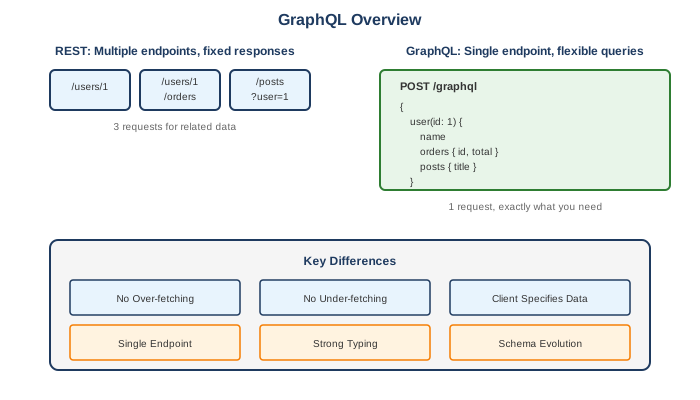
Query language for APIs that allows clients to request exactly the data they need.
Schema Definition Language (SDL)
Types
# Scalar types (built-in)
# String, Int, Float, Boolean, ID

# Object type
type User {
  id: ID!
  email: String!
  name: String
  age: Int
  isActive: Boolean!
  createdAt: DateTime!

  # Relations
  orders: [Order!]!
  address: Address
}

type Order {
  id: ID!
  orderNumber: String!
  status: OrderStatus!
  total: Float!
  items: [OrderItem!]!
  customer: User!
  createdAt: DateTime!
}

type OrderItem {
  id: ID!
  product: Product!
  quantity: Int!
  unitPrice: Float!
  subtotal: Float!
}

type Address {
  street: String!
  city: String!
  state: String
  postalCode: String!
  country: String!
}

# Enum type
enum OrderStatus {
  PENDING
  CONFIRMED
  SHIPPED
  DELIVERED
  CANCELLED
}

# Input type (for mutations)
input CreateOrderInput {
  customerId: ID!
  items: [OrderItemInput!]!
  shippingAddress: AddressInput!
}

input OrderItemInput {
  productId: ID!
  quantity: Int!
}

input AddressInput {
  street: String!
  city: String!
  state: String
  postalCode: String!
  country: String!
}

# Interface
interface Node {
  id: ID!
}

type User implements Node {
  id: ID!
  # ... other fields
}

# Union type
union SearchResult = User | Product | Order

# Custom scalar
scalar DateTime
scalar JSON
Schema Entry Points
type Query {
  # Single item
  user(id: ID!): User
  order(id: ID!): Order

  # Lists with pagination
  users(first: Int, after: String): UserConnection!
  orders(
    status: OrderStatus
    customerId: ID
    first: Int
    after: String
  ): OrderConnection!

  # Search
  search(query: String!): [SearchResult!]!
}

type Mutation {
  createUser(input: CreateUserInput!): CreateUserPayload!
  updateUser(id: ID!, input: UpdateUserInput!): UpdateUserPayload!
  deleteUser(id: ID!): DeleteUserPayload!

  createOrder(input: CreateOrderInput!): CreateOrderPayload!
  cancelOrder(id: ID!, reason: String): CancelOrderPayload!
}

type Subscription {
  orderStatusChanged(orderId: ID!): Order!
  newOrder(customerId: ID): Order!
}

schema {
  query: Query
  mutation: Mutation
  subscription: Subscription
}
Queries
Basic Queries
# Simple query
query GetUser {
  user(id: "123") {
    id
    name
    email
  }
}

# Query with variables
query GetUser($userId: ID!) {
  user(id: $userId) {
    id
    name
    email
    orders {
      id
      total
      status
    }
  }
}

# Variables (sent with query)
{
  "userId": "123"
}

# Multiple queries in one request
query GetUserAndOrders($userId: ID!) {
  user(id: $userId) {
    name
    email
  }

  recentOrders: orders(customerId: $userId, first: 5) {
    edges {
      node {
        id
        total
      }
    }
  }
}
Fragments
# Reusable field selection
fragment UserBasic on User {
  id
  name
  email
}

fragment OrderSummary on Order {
  id
  orderNumber
  status
  total
}

query GetOrderWithUsers($orderId: ID!) {
  order(id: $orderId) {
    ...OrderSummary
    customer {
      ...UserBasic
    }
    items {
      product {
        name
        price
      }
      quantity
    }
  }
}

# Inline fragments (for unions/interfaces)
query Search($query: String!) {
  search(query: $query) {
    ... on User {
      name
      email
    }
    ... on Product {
      name
      price
    }
    ... on Order {
      orderNumber
      total
    }
  }
}
Directives
query GetUser($userId: ID!, $includeOrders: Boolean!, $skipEmail: Boolean!) {
  user(id: $userId) {
    id
    name
    email @skip(if: $skipEmail)
    orders @include(if: $includeOrders) {
      id
      total
    }
  }
}

# Built-in directives
@skip(if: Boolean!)      # Skip field if true
@include(if: Boolean!)   # Include field if true
@deprecated(reason: String)  # Mark as deprecated
Mutations
# Create
mutation CreateOrder($input: CreateOrderInput!) {
  createOrder(input: $input) {
    order {
      id
      orderNumber
      status
      total
    }
    errors {
      field
      message
    }
  }
}

# Update
mutation UpdateOrderStatus($orderId: ID!, $status: OrderStatus!) {
  updateOrderStatus(id: $orderId, status: $status) {
    order {
      id
      status
      updatedAt
    }
    errors {
      message
    }
  }
}

# Delete
mutation CancelOrder($orderId: ID!, $reason: String) {
  cancelOrder(id: $orderId, reason: $reason) {
    success
    order {
      id
      status
    }
    errors {
      message
    }
  }
}

# Variables
{
  "input": {
    "customerId": "cust_123",
    "items": [
      { "productId": "prod_456", "quantity": 2 }
    ],
    "shippingAddress": {
      "street": "123 Main St",
      "city": "New York",
      "postalCode": "10001",
      "country": "US"
    }
  }
}
Mutation Response Pattern
# Payload types for mutations
type CreateOrderPayload {
  order: Order
  errors: [UserError!]!
  clientMutationId: String  # For client-side tracking
}

type UserError {
  field: [String!]  # Path to field with error
  message: String!
  code: String
}

# Usage ensures type-safe error handling
mutation CreateOrder($input: CreateOrderInput!) {
  createOrder(input: $input) {
    order {
      id
    }
    errors {
      field
      message
      code
    }
  }
}
Subscriptions
# Schema
type Subscription {
  orderStatusChanged(orderId: ID!): OrderStatusUpdate!
  newOrders: Order!
}

type OrderStatusUpdate {
  order: Order!
  previousStatus: OrderStatus!
  newStatus: OrderStatus!
  changedAt: DateTime!
}

# Client subscription
subscription WatchOrder($orderId: ID!) {
  orderStatusChanged(orderId: $orderId) {
    order {
      id
      status
    }
    previousStatus
    newStatus
    changedAt
  }
}
Pagination
Cursor-Based (Relay Connection Spec)
# Schema
type Query {
  orders(
    first: Int
    after: String
    last: Int
    before: String
    filter: OrderFilter
  ): OrderConnection!
}

type OrderConnection {
  edges: [OrderEdge!]!
  pageInfo: PageInfo!
  totalCount: Int!
}

type OrderEdge {
  node: Order!
  cursor: String!
}

type PageInfo {
  hasNextPage: Boolean!
  hasPreviousPage: Boolean!
  startCursor: String
  endCursor: String
}

# Query
query GetOrders($after: String) {
  orders(first: 10, after: $after) {
    edges {
      node {
        id
        orderNumber
        total
      }
      cursor
    }
    pageInfo {
      hasNextPage
      endCursor
    }
    totalCount
  }
}
Offset-Based (Simpler)
type Query {
  orders(
    offset: Int = 0
    limit: Int = 20
    filter: OrderFilter
  ): OrderList!
}

type OrderList {
  items: [Order!]!
  total: Int!
  hasMore: Boolean!
}
Java Implementation (Spring GraphQL)
Schema-First Approach
// Controller
@Controller
public class OrderController {

    private final OrderService orderService;

    // Query resolver
    @QueryMapping
    public Order order(@Argument String id) {
        return orderService.findById(id)
            .orElseThrow(() -> new OrderNotFoundException(id));
    }

    @QueryMapping
    public Connection<Order> orders(
            @Argument OrderFilter filter,
            @Argument int first,
            @Argument String after) {
        return orderService.findAll(filter, first, after);
    }

    // Mutation resolver
    @MutationMapping
    public CreateOrderPayload createOrder(@Argument CreateOrderInput input) {
        try {
            Order order = orderService.create(input);
            return CreateOrderPayload.success(order);
        } catch (ValidationException e) {
            return CreateOrderPayload.error(e.getErrors());
        }
    }

    // Field resolver (for relations)
    @SchemaMapping(typeName = "Order", field = "customer")
    public User customer(Order order) {
        return userService.findById(order.getCustomerId());
    }

    @SchemaMapping(typeName = "Order", field = "items")
    public List<OrderItem> items(Order order) {
        return orderItemService.findByOrderId(order.getId());
    }
}

// Subscription
@Controller
public class OrderSubscriptionController {

    @SubscriptionMapping
    public Flux<Order> orderStatusChanged(@Argument String orderId) {
        return orderEventPublisher.subscribe(orderId);
    }
}
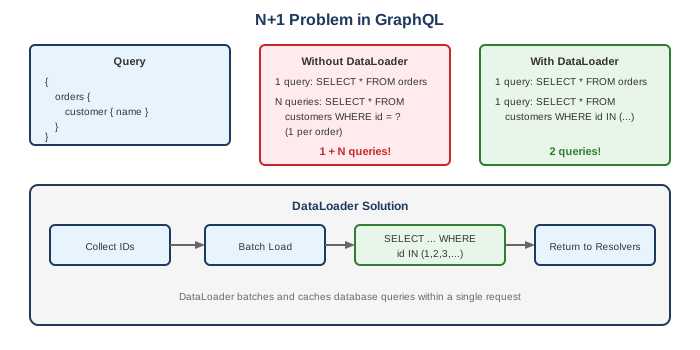
DataLoader (N+1 Solution)
@Configuration
public class DataLoaderConfig {

    @Bean
    public BatchLoaderRegistry batchLoaderRegistry(UserService userService) {
        return registry -> {
            registry.forTypePair(String.class, User.class)
                .registerMappedBatchLoader((userIds, env) -> {
                    // Batch load users
                    Map<String, User> users = userService.findByIds(userIds);
                    return Mono.just(users);
                });
        };
    }
}

@Controller
public class OrderController {

    @SchemaMapping(typeName = "Order", field = "customer")
    public CompletableFuture<User> customer(
            Order order,
            DataLoader<String, User> userLoader) {
        return userLoader.load(order.getCustomerId());
    }
}
N+1 Problem
Error Handling
# Standard GraphQL error format
{
  "data": {
    "createOrder": null
  },
  "errors": [
    {
      "message": "Insufficient inventory for product prod_123",
      "locations": [{ "line": 2, "column": 3 }],
      "path": ["createOrder"],
      "extensions": {
        "code": "INSUFFICIENT_INVENTORY",
        "productId": "prod_123",
        "available": 5,
        "requested": 10
      }
    }
  ]
}

# Application-level errors in response
{
  "data": {
    "createOrder": {
      "order": null,
      "errors": [
        {
          "field": ["input", "items", "0", "quantity"],
          "message": "Insufficient inventory",
          "code": "INSUFFICIENT_INVENTORY"
        }
      ]
    }
  }
}
Java Error Handling
@ControllerAdvice
public class GraphQLExceptionHandler {

    @ExceptionHandler(OrderNotFoundException.class)
    public GraphQLError handleNotFound(OrderNotFoundException ex) {
        return GraphQLError.newError()
            .message(ex.getMessage())
            .errorType(ErrorType.NOT_FOUND)
            .extensions(Map.of(
                "code", "ORDER_NOT_FOUND",
                "orderId", ex.getOrderId()
            ))
            .build();
    }

    @ExceptionHandler(ValidationException.class)
    public GraphQLError handleValidation(ValidationException ex) {
        return GraphQLError.newError()
            .message("Validation failed")
            .errorType(ErrorType.BAD_REQUEST)
            .extensions(Map.of(
                "code", "VALIDATION_ERROR",
                "errors", ex.getErrors()
            ))
            .build();
    }
}
Security
Authentication & Authorization
@Controller
public class OrderController {

    @QueryMapping
    @PreAuthorize("isAuthenticated()")
    public Order order(@Argument String id) {
        return orderService.findById(id);
    }

    @MutationMapping
    @PreAuthorize("hasRole('ADMIN') or @orderSecurity.isOwner(#id)")
    public CancelOrderPayload cancelOrder(@Argument String id) {
        return orderService.cancel(id);
    }
}

// Field-level authorization
@SchemaMapping(typeName = "User", field = "email")
@PreAuthorize("hasRole('ADMIN') or #user.id == authentication.principal.id")
public String email(User user) {
    return user.getEmail();
}
Query Complexity & Depth Limiting
@Configuration
public class GraphQLSecurityConfig {

    @Bean
    public Instrumentation maxQueryDepthInstrumentation() {
        return new MaxQueryDepthInstrumentation(10);
    }

    @Bean
    public Instrumentation maxQueryComplexityInstrumentation() {
        return new MaxQueryComplexityInstrumentation(100);
    }
}

// Schema complexity directives
type Query {
  orders(first: Int): [Order!]! @complexity(value: 10, multiplier: "first")
}
GraphQL vs REST
| Aspect | GraphQL | REST |
|---|---|---|
| Endpoints | Single (/graphql) | Multiple |
| Data fetching | Client specifies | Server determines |
| Over-fetching | No | Common |
| Under-fetching | No | Common |
| Versioning | Schema evolution | URL/header versioning |
| Caching | Complex | HTTP caching built-in |
| File upload | Not native | Native |
| Learning curve | Steeper | Lower |
| Tooling | Growing | Mature |
When to use GraphQL: - Complex, nested data requirements - Multiple clients with different needs - Rapid frontend iteration - Mobile apps (bandwidth concerns)
When to use REST: - Simple CRUD operations - Public APIs (caching important) - File operations - Team unfamiliar with GraphQL
Common Interview Questions
- What is GraphQL?
- Query language for APIs
- Client specifies exactly what data needed
-
Single endpoint, flexible queries
-
How to solve N+1 problem?
- DataLoader pattern
-
Batch and cache database queries
-
GraphQL vs REST?
- GraphQL: Flexible queries, single endpoint
-
REST: Multiple endpoints, HTTP caching
-
How to handle errors?
- Standard errors array
- Application-level errors in response payload
-
Extensions for additional context
-
Security concerns?
- Query depth/complexity limiting
- Authentication/authorization
- Rate limiting
- Disable introspection in production