AWS Lambda
Introduction
AWS Lambda is a serverless compute service that runs code in response to events and automatically manages the underlying compute resources. You pay only for the compute time consumed.
Key Features
- No servers to manage - Focus on code, not infrastructure
- Automatic scaling - Scales from zero to thousands of concurrent executions
- Pay per use - Charged per request and compute duration
- Event-driven - Triggered by AWS services or HTTP requests
- Multiple runtimes - Python, Node.js, Java, Go, Ruby, .NET, custom runtimes
When to Use
Ideal Use Cases
- API backends - Via API Gateway or Function URLs
- Data processing - S3 uploads, Kinesis streams, DynamoDB streams
- Scheduled tasks - Cron jobs via EventBridge
- Real-time file processing - Image resizing, video transcoding
- IoT backends - Process IoT device data
- Chatbots - Lex fulfillment
- Automation - Infrastructure automation, CloudWatch alarms response
Signs Lambda is Right for You
- Workloads are event-driven
- Traffic is variable or unpredictable
- You want to minimize operational overhead
- Execution time is under 15 minutes
- You need rapid scaling from zero
Execution Model
Invocation Types
| Type | Description | Use Case |
|---|---|---|
| Synchronous | Wait for response | API Gateway, direct invoke |
| Asynchronous | Fire and forget | S3, SNS, EventBridge |
| Event Source Mapping | Poll-based | SQS, Kinesis, DynamoDB Streams |
Cold Start vs Warm Start
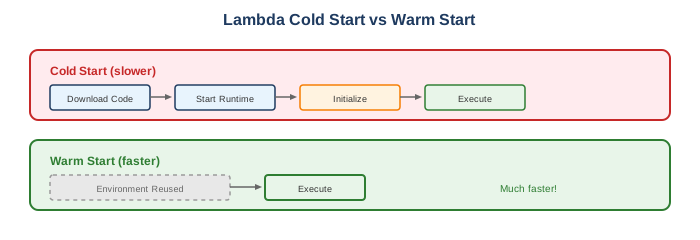
What to Be Careful About
Limits and Constraints
- Execution timeout - Max 15 minutes
- Memory - 128 MB to 10,240 MB
- Package size - 50 MB zipped, 250 MB unzipped (layers included)
- Concurrent executions - 1,000 default (can be increased)
- Payload size - 6 MB sync, 256 KB async
- /tmp storage - 512 MB to 10,240 MB
Cost Management
- Invocation costs - $0.20 per 1M requests
- Duration costs - Based on memory allocation and time
- Over-provisioned memory - Paying for unused memory
- Unnecessary invocations - Ensure proper error handling to avoid retries
- Provisioned concurrency - Costs even when not used
Cold Starts
- VPC Lambda - Longer cold starts (though improved with Hyperplane ENIs)
- Large packages - More code = longer cold start
- Heavy initialization - SDK/database connections in init phase
- Mitigation - Provisioned Concurrency, keep functions warm
Security
- IAM execution role - Follow least privilege
- Environment variables - Use KMS encryption for secrets
- VPC considerations - No internet access without NAT Gateway
- Resource policies - Control who can invoke your function
Architecture
- Stateless - Don't rely on local state between invocations
- Idempotency - Functions may be invoked multiple times
- Timeout handling - Graceful handling of approaching timeout
- Dead letter queues - Configure for async failures
Key Components
Layers
- Reusable code/libraries across functions
- Up to 5 layers per function
- Reduce deployment package size
- Share common dependencies
Versions and Aliases
- Version - Immutable snapshot of function code and config
- Alias - Pointer to a version (e.g., "prod" → v5)
- Traffic shifting - Weighted aliases for canary deployments
Destinations
Configure where results go for async invocations: - On Success: SQS, SNS, Lambda, EventBridge - On Failure: SQS, SNS, Lambda, EventBridge
Environment Variables
- Key-value pairs available to function
- Can be encrypted with KMS
- Max 4 KB total size
Pricing Model
| Component | Cost |
|---|---|
| Requests | $0.20 per 1 million requests |
| Duration | $0.0000166667 per GB-second |
| Provisioned Concurrency | $0.000004646 per GB-second |
| Free Tier | 1M requests, 400,000 GB-seconds/month |
Example: 1M invocations, 1 GB memory, 200ms average - Requests: $0.20 - Duration: 1M × 0.2s × 1GB × $0.0000166667 = $3.33 - Total: ~$3.53/month
Common Interview Questions
- How do you handle Lambda cold starts?
- Use Provisioned Concurrency for consistent latency
- Keep initialization code outside handler
- Use smaller deployment packages
- Choose faster runtimes (Node.js, Python vs Java)
-
Avoid VPC if not necessary
-
How do you make Lambda functions secure?
- Least privilege IAM execution role
- Encrypt environment variables with KMS
- Use Secrets Manager for sensitive data
- Enable X-Ray for tracing
-
Use VPC for private resource access
-
What's the difference between sync and async invocation?
- Sync: Caller waits for response, errors returned immediately
-
Async: Fire and forget, Lambda handles retries (2 times), use DLQ
-
How does Lambda scale?
- Automatic scaling based on concurrent requests
- Each instance handles one request at a time
- Burst capacity of 500-3000 (region dependent)
-
After burst, scales at 500 instances/minute
-
How do you share code between Lambda functions?
- Lambda Layers for shared libraries
- Deploy common code as a layer
- Each function can use up to 5 layers
Alternatives
AWS Alternatives
| Service | When to Use Instead |
|---|---|
| EC2 | Long-running processes, full OS control |
| Fargate | Containerized workloads, longer execution |
| App Runner | Containerized web services |
| Step Functions | Complex workflows orchestrating multiple Lambdas |
| Batch | Large-scale batch computing jobs |
External Alternatives
| Provider | Service |
|---|---|
| Google Cloud | Cloud Functions, Cloud Run |
| Azure | Azure Functions |
| Cloudflare | Workers |
| Vercel | Serverless Functions |
Best Practices
- Keep functions focused - Single responsibility
- Minimize package size - Faster cold starts
- Reuse connections - Initialize SDK clients outside handler
- Use environment variables - Don't hardcode configuration
- Set appropriate timeout - Don't use max unless needed
- Right-size memory - More memory = more CPU
- Enable X-Ray - Distributed tracing
- Use structured logging - JSON format for CloudWatch Insights
- Implement idempotency - Handle duplicate invocations
- Monitor with CloudWatch - Alarms on errors, duration, throttles
Event Sources
| Source | Invocation Type | Notes |
|---|---|---|
| API Gateway | Sync | REST/HTTP APIs |
| S3 | Async | Object events |
| DynamoDB Streams | Event Source Mapping | Table changes |
| Kinesis | Event Source Mapping | Stream processing |
| SQS | Event Source Mapping | Queue processing |
| SNS | Async | Pub/sub messages |
| EventBridge | Async | Scheduled/event rules |
| CloudWatch Logs | Async | Log subscriptions |
| Cognito | Sync | Auth triggers |
| ALB | Sync | Load balancer target |