Amazon API Gateway
Introduction
Amazon API Gateway is a fully managed service that makes it easy for developers to create, publish, maintain, monitor, and secure APIs at any scale. It acts as a "front door" for applications to access data, business logic, or functionality from backend services.
Key Features
- RESTful and WebSocket APIs - Support for different API types
- Serverless - No infrastructure to manage
- Multiple backends - Lambda, HTTP, AWS services
- Security - IAM, Cognito, API keys, Lambda authorizers
- Throttling - Rate limiting and burst control
- Caching - Reduce backend calls
- OpenAPI support - Import/export API definitions
When to Use
Ideal Use Cases
- Serverless backends - API Gateway + Lambda
- Microservices - Unified API layer
- Mobile/Web backends - REST APIs for apps
- Real-time applications - WebSocket APIs
- API monetization - Usage plans and API keys
- Legacy modernization - Facade for legacy systems
Signs API Gateway is Right for You
- Need managed API infrastructure
- Want built-in authentication/authorization
- Need request/response transformation
- Want usage tracking and throttling
- Building serverless applications
API Types
REST API
- Full-featured, original API type
- Request/response transformation
- API keys, usage plans
- Caching support
- Private integrations (VPC)
HTTP API
- Lower latency, lower cost
- Simpler feature set
- JWT authorizers built-in
- Best for Lambda/HTTP backends
- 70% cheaper than REST API
WebSocket API
- Real-time, bidirectional communication
- Persistent connections
- Use for: Chat, gaming, dashboards
Comparison
| Feature | REST API | HTTP API | WebSocket |
|---|---|---|---|
| Cost | Higher | 70% less | Per message |
| Latency | Higher | Lower | Real-time |
| Caching | Yes | No | N/A |
| Request transform | Full | Limited | No |
| Private integration | Yes | Yes | No |
| Usage plans | Yes | No | No |
What to Be Careful About
Performance
- Cold starts - Lambda integration adds latency
- Timeout - 29 second maximum (30s for Lambda)
- Payload size - 10 MB max (REST), 6 MB (Lambda)
- Caching - Only available in REST API
- Regional vs Edge - Choose based on client locations
Cost Management
- Request pricing - $3.50 per million (REST)
- Data transfer - Standard AWS rates
- Caching - Additional cost for cache instances
- HTTP API is cheaper - Use when features allow
- WebSocket - Charged per message and connection
Security
- Authentication - Choose appropriate method
- Authorization - Configure carefully
- API keys - Not for authentication (only identification)
- CORS - Configure properly for browser access
- WAF integration - REST API only
Limits
- Throttling - Default 10,000 RPS account limit
- Burst - 5,000 concurrent requests
- Stages - Limited stages per API
- Resources - Limited resources per API
Integration Types
| Type | Description | Use Case |
|---|---|---|
| Lambda | Invoke Lambda function | Serverless backends |
| HTTP | Proxy to HTTP endpoint | Existing services |
| AWS Service | Direct AWS service integration | S3, DynamoDB, SQS |
| Mock | Return static response | Testing, prototyping |
| VPC Link | Private resources | NLB in VPC |
Authentication & Authorization
Methods
| Method | Description | Use Case |
|---|---|---|
| IAM | AWS Signature V4 | AWS clients, internal |
| Cognito | User pools | Web/mobile users |
| Lambda Authorizer | Custom auth logic | Third-party tokens |
| API Keys | Usage identification | Tracking, throttling |
| JWT | HTTP API only | OAuth/OIDC tokens |
Lambda Authorizer Types
- Token-based - Validate bearer token
- Request-based - Validate headers, query strings
Common Interview Questions
- What's the difference between REST API and HTTP API?
- REST API: Full-featured, caching, usage plans, higher cost
- HTTP API: Simpler, lower latency, 70% cheaper
-
HTTP API for most new serverless applications
-
How do you secure an API Gateway endpoint?
- IAM authorization (AWS clients)
- Cognito authorizer (user pools)
- Lambda authorizer (custom logic)
- API keys (not for security, for tracking)
-
WAF (web application firewall)
-
What is a Lambda authorizer?
- Lambda function that validates requests
- Returns IAM policy allowing/denying access
- Caching available for performance
-
Two types: token-based, request-based
-
How do you handle throttling?
- Configure usage plans
- Set rate limit and burst
- Per-method throttling
- Account-level limits exist
-
Return 429 Too Many Requests
-
What are stages in API Gateway?
- Deployment snapshots
- Environment representation (dev, staging, prod)
- Stage variables for configuration
- Canary deployments supported
Request/Response Flow
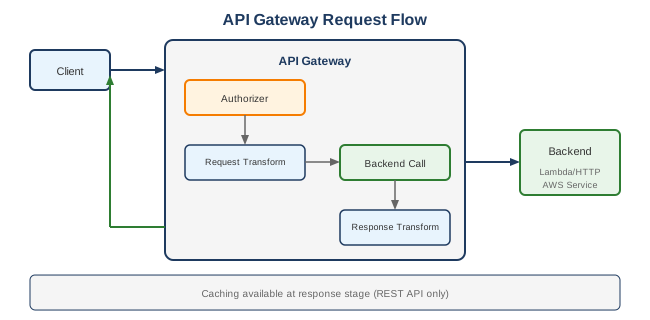
Mapping Templates
- Velocity Template Language (VTL)
- Transform request/response
- Access context variables
- REST API feature (limited in HTTP API)
Caching (REST API)
- Reduce backend calls
- Cache per stage
- TTL: 0-3600 seconds
- Cache sizes: 0.5 GB to 237 GB
- Cache key: URL path, query strings, headers
- Invalidation via API or TTL
Alternatives
AWS Alternatives
| Service | When to Use Instead |
|---|---|
| AppSync | GraphQL APIs |
| Lambda Function URLs | Simple Lambda invocation |
| ALB | Container/EC2 backends |
| CloudFront | Static content, edge functions |
External Alternatives
| Provider | Service |
|---|---|
| Kong | API gateway platform |
| Apigee | Google Cloud API management |
| Azure | Azure API Management |
| Tyk | Open-source API gateway |
Best Practices
- Use HTTP API - When full REST API features not needed
- Enable caching - Reduce backend load (REST API)
- Set up throttling - Protect backends from overload
- Use Lambda authorizers wisely - Cache authorization results
- Configure CORS properly - Required for browser access
- Use stages - Separate environments
- Enable CloudWatch logging - Debug and monitor
- Use WAF - Protect against common attacks
- Set appropriate timeouts - Don't waste resources
- Use request validation - Fail fast on bad requests
Pricing Summary
| Component | REST API | HTTP API |
|---|---|---|
| First 333M requests | $3.50/million | $1.00/million |
| Over 333M requests | $2.80/million | $0.90/million |
| Caching | $0.02-$3.80/hour | N/A |
| Data transfer | Standard rates | Standard rates |
| WebSocket | $1.00/million messages | N/A |