Scaling Writes
The Problem
When write traffic overwhelms your database: - Single database becomes bottleneck - Transaction throughput limited - Disk I/O saturation - Replication lag increases - Write latency grows
Write-heavy systems: - Logging/metrics collection - IoT sensor data - Social media posts/activity - Gaming leaderboards - Real-time analytics - Message queues
Options & Trade-offs
1. Database Sharding (Horizontal Partitioning)
Philosophy: "Divide data across multiple database instances"
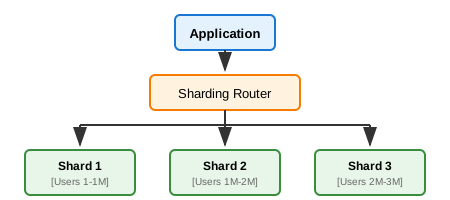
Sharding Strategies
Hash-Based Sharding:
public class HashShardRouter {
    private static final int NUM_SHARDS = 8;

    public int getShard(String userId) {
        int hash = Math.abs(userId.hashCode());
        return hash % NUM_SHARDS;
    }
}

// More consistent: Consistent Hashing
public class ConsistentHashRouter {
    private final TreeMap<Long, Integer> ring = new TreeMap<>();
    private final int virtualNodes = 100;

    public void addShard(int shardId) {
        for (int i = 0; i < virtualNodes; i++) {
            long hash = hash(shardId + "-" + i);
            ring.put(hash, shardId);
        }
    }

    public int getShard(String key) {
        long hash = hash(key);
        Map.Entry<Long, Integer> entry = ring.ceilingEntry(hash);
        return entry != null ? entry.getValue() : ring.firstEntry().getValue();
    }
}
| Pros | Cons |
|---|---|
| Even distribution | Cross-shard queries complex |
| Easy to add shards | Resharding is hard |
| Good for random access | No range queries |
Range-Based Sharding:
public class RangeShardRouter {
    // Users A-H → Shard 1, I-P → Shard 2, Q-Z → Shard 3
    public int getShard(String username) {
        char first = Character.toUpperCase(username.charAt(0));
        if (first <= 'H') return 1;
        if (first <= 'P') return 2;
        return 3;
    }
}
| Pros | Cons |
|---|---|
| Range queries work | Hotspots (uneven distribution) |
| Logical grouping | Resharding still hard |
| Easy to understand | Popular ranges get hammered |
Directory-Based Sharding:
public class DirectoryShardRouter {
    private final Map<String, Integer> lookupTable;

    public int getShard(String entityId) {
        // Lookup in directory service
        return lookupTable.get(entityId);
    }

    public void moveShard(String entityId, int newShard) {
        lookupTable.put(entityId, newShard);
    }
}
| Pros | Cons |
|---|---|
| Flexible placement | Lookup overhead |
| Easy rebalancing | Directory is SPOF |
| Custom logic | Additional latency |
Geographic Sharding:
public class GeoShardRouter {
    public int getShard(String region) {
        return switch (region) {
            case "US" -> 1;
            case "EU" -> 2;
            case "ASIA" -> 3;
            default -> 1;
        };
    }
}
| Pros | Cons |
|---|---|
| Data locality | Global queries hard |
| Lower latency | Uneven distribution |
| Compliance (data residency) | Cross-region operations |
Cross-Shard Operations
// Scatter-Gather for cross-shard queries
public List<User> searchUsers(String query) {
    List<CompletableFuture<List<User>>> futures = shards.stream()
        .map(shard -> CompletableFuture.supplyAsync(() ->
            shard.search(query)))
        .collect(Collectors.toList());

    return futures.stream()
        .map(CompletableFuture::join)
        .flatMap(List::stream)
        .sorted(Comparator.comparing(User::getRelevance).reversed())
        .limit(100)
        .collect(Collectors.toList());
}
2. Write-Behind Caching (Async Writes)
Philosophy: "Accept writes fast, persist asynchronously"
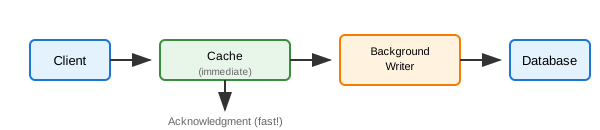
Implementation:
public class WriteBehindService {
    private final Cache cache;
    private final BlockingQueue<WriteOperation> writeQueue;
    private final ScheduledExecutorService scheduler;

    public void save(Entity entity) {
        // Immediate cache update
        cache.put(entity.getId(), entity);

        // Queue for async database write
        writeQueue.offer(new WriteOperation(entity));
    }

    @PostConstruct
    public void startBackgroundWriter() {
        scheduler.scheduleWithFixedDelay(() -> {
            List<WriteOperation> batch = new ArrayList<>();
            writeQueue.drainTo(batch, 100);

            if (!batch.isEmpty()) {
                try {
                    database.batchInsert(batch);
                    log.info("Persisted {} entities", batch.size());
                } catch (Exception e) {
                    // Re-queue failed operations
                    writeQueue.addAll(batch);
                    log.error("Batch write failed, re-queued", e);
                }
            }
        }, 0, 1, TimeUnit.SECONDS);
    }
}
| Pros | Cons |
|---|---|
| Very fast writes | Data loss risk |
| Batching = efficient | Complexity |
| Reduces DB load | Read-your-writes issues |
| Smooths traffic spikes |
When to use: - Analytics/metrics - Logging - Non-critical data - When some data loss is acceptable
3. Event Sourcing
Philosophy: "Store changes as immutable events, not current state"
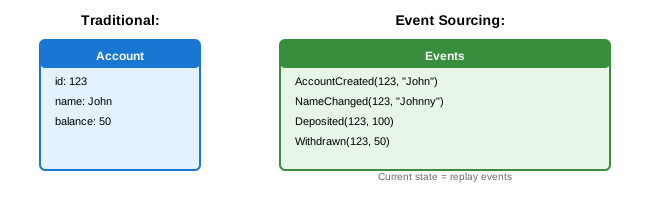
Implementation:
// Events
public sealed interface AccountEvent {
    String accountId();
}

public record AccountCreated(String accountId, String name,
                             BigDecimal initialBalance) implements AccountEvent {}
public record MoneyDeposited(String accountId, BigDecimal amount) implements AccountEvent {}
public record MoneyWithdrawn(String accountId, BigDecimal amount) implements AccountEvent {}

// Event Store
@Repository
public class EventStore {
    public void append(String streamId, AccountEvent event) {
        EventRecord record = new EventRecord(
            UUID.randomUUID(),
            streamId,
            event.getClass().getSimpleName(),
            serialize(event),
            Instant.now()
        );
        eventRepository.save(record);
    }

    public List<AccountEvent> getEvents(String streamId) {
        return eventRepository.findByStreamIdOrderByTimestamp(streamId)
            .stream()
            .map(this::deserialize)
            .collect(Collectors.toList());
    }
}

// Aggregate (reconstructed from events)
public class Account {
    private String id;
    private String name;
    private BigDecimal balance = BigDecimal.ZERO;

    public static Account reconstitute(List<AccountEvent> events) {
        Account account = new Account();
        events.forEach(account::apply);
        return account;
    }

    private void apply(AccountEvent event) {
        switch (event) {
            case AccountCreated e -> {
                this.id = e.accountId();
                this.name = e.name();
                this.balance = e.initialBalance();
            }
            case MoneyDeposited e -> this.balance = balance.add(e.amount());
            case MoneyWithdrawn e -> this.balance = balance.subtract(e.amount());
        }
    }
}
| Pros | Cons |
|---|---|
| Complete audit trail | Complexity |
| Append-only (fast writes) | Event schema evolution |
| Temporal queries | Eventual consistency |
| Replay/debug | Storage grows |
| Natural fit for CQRS |
When to use: - Audit requirements (finance, healthcare) - Complex business logic - When history matters - Event-driven architectures
4. Message Queues (Async Processing)
Philosophy: "Decouple write acceptance from processing"
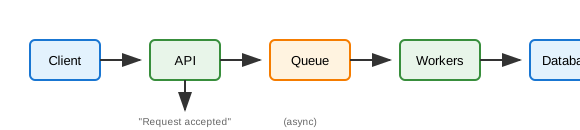
Implementation:
// Producer (API)
@PostMapping("/orders")
public ResponseEntity<OrderResponse> createOrder(@RequestBody OrderRequest request) {
    String orderId = UUID.randomUUID().toString();

    // Publish to queue
    OrderMessage message = new OrderMessage(orderId, request);
    kafkaTemplate.send("orders", orderId, message);

    // Return immediately
    return ResponseEntity.accepted()
        .body(new OrderResponse(orderId, "PENDING"));
}

// Consumer (Worker)
@KafkaListener(topics = "orders", groupId = "order-processors")
public void processOrder(OrderMessage message) {
    try {
        Order order = orderService.create(message);
        database.save(order);

        // Publish success event
        eventPublisher.publish(new OrderCreatedEvent(order));
    } catch (Exception e) {
        // Send to dead letter queue
        kafkaTemplate.send("orders-dlq", message);
    }
}
Scaling Workers:
# Kubernetes HPA
apiVersion: autoscaling/v2
kind: HorizontalPodAutoscaler
metadata:
  name: order-worker
spec:
  scaleTargetRef:
    apiVersion: apps/v1
    kind: Deployment
    name: order-worker
  minReplicas: 2
  maxReplicas: 20
  metrics:
  - type: External
    external:
      metric:
        name: kafka_consumer_lag
      target:
        type: AverageValue
        averageValue: "1000"
| Pros | Cons |
|---|---|
| Decouples components | Complexity |
| Handles traffic spikes | Eventual consistency |
| Retry capability | Monitoring overhead |
| Scale workers independently | Message ordering |
| Natural backpressure |
5. Batch Processing
Philosophy: "Accumulate writes, process in bulk"
public class BatchWriter {
    private final List<Entity> buffer = new ArrayList<>();
    private final int batchSize = 1000;
    private final Duration maxWait = Duration.ofSeconds(5);
    private Instant lastFlush = Instant.now();

    public synchronized void write(Entity entity) {
        buffer.add(entity);

        if (buffer.size() >= batchSize ||
            Duration.between(lastFlush, Instant.now()).compareTo(maxWait) > 0) {
            flush();
        }
    }

    private void flush() {
        if (buffer.isEmpty()) return;

        List<Entity> batch = new ArrayList<>(buffer);
        buffer.clear();
        lastFlush = Instant.now();

        // Bulk insert
        database.batchInsert(batch);
    }
}

// Using Spring Batch
@Bean
public Job importJob(JobRepository jobRepository, Step step1) {
    return new JobBuilder("importJob", jobRepository)
        .start(step1)
        .build();
}

@Bean
public Step step1(JobRepository jobRepository,
                  PlatformTransactionManager transactionManager) {
    return new StepBuilder("step1", jobRepository)
        .<InputData, Entity>chunk(1000, transactionManager)
        .reader(reader())
        .processor(processor())
        .writer(writer())
        .build();
}
| Pros | Cons |
|---|---|
| Efficient bulk operations | Latency (waiting for batch) |
| Reduces DB round trips | Memory usage |
| Better I/O patterns | Partial failure handling |
| Less overhead |
6. Time-Series Databases
Philosophy: "Use databases optimized for time-stamped data"
Options: - InfluxDB - Popular, easy to use - TimescaleDB - PostgreSQL extension - ClickHouse - Very fast analytics - Apache Druid - Real-time analytics - Prometheus - Metrics focused
-- TimescaleDB example
CREATE TABLE metrics (
    time        TIMESTAMPTZ NOT NULL,
    sensor_id   INTEGER,
    temperature DOUBLE PRECISION,
    humidity    DOUBLE PRECISION
);

SELECT create_hypertable('metrics', 'time');

-- Automatic partitioning by time
-- Efficient time-range queries
-- Built-in compression
-- Retention policies
| Pros | Cons |
|---|---|
| Optimized for time data | Limited query patterns |
| High write throughput | Learning curve |
| Built-in retention | May need migration |
| Efficient aggregations |
7. LSM Tree Databases
Philosophy: "Optimize for writes with log-structured storage"
How LSM Trees Work:
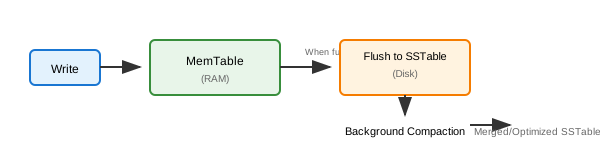
Databases using LSM: - Cassandra - RocksDB - LevelDB - HBase - ScyllaDB
// Cassandra example - Write-optimized
@Table("user_activity")
public class UserActivity {
    @PartitionKey
    private UUID userId;

    @ClusteringColumn
    private Instant timestamp;

    private String action;
    private String details;
}

// Writes are extremely fast (append-only)
// Reads require merging multiple SSTables
| Pros | Cons |
|---|---|
| Very fast writes | Slower reads |
| Append-only (durable) | Write amplification |
| SSD-friendly | Space amplification |
| Good for time-series | Compaction CPU usage |
8. Distributed Databases
Philosophy: "Built for scale from the ground up"
Options:
| Database | Type | Best For |
|---|---|---|
| Cassandra | Wide-column | High write throughput |
| CockroachDB | Distributed SQL | ACID at scale |
| TiDB | Distributed SQL | MySQL compatible |
| YugabyteDB | Distributed SQL | PostgreSQL compatible |
| Vitess | MySQL sharding | MySQL at scale |
| Spanner | Distributed SQL | Global consistency |
// CockroachDB - Distributed PostgreSQL-compatible
// Automatic sharding, replication, and rebalancing

@Entity
public class Order {
    @Id
    @GeneratedValue(strategy = GenerationType.AUTO)
    private UUID id;  // UUID recommended for distribution

    private String customerId;
    private BigDecimal amount;
}

// Same JPA code, database handles distribution
9. Write Optimization Techniques
Disable/Defer Indexes:
-- Bulk load without indexes
ALTER TABLE orders DISABLE KEYS;
-- Load data
LOAD DATA INFILE 'orders.csv' INTO TABLE orders;
-- Re-enable and rebuild
ALTER TABLE orders ENABLE KEYS;
Prepared Statements (Reduce Parse Time):
PreparedStatement ps = conn.prepareStatement(
    "INSERT INTO orders (id, customer_id, amount) VALUES (?, ?, ?)"
);

for (Order order : orders) {
    ps.setString(1, order.getId());
    ps.setString(2, order.getCustomerId());
    ps.setBigDecimal(3, order.getAmount());
    ps.addBatch();
}

ps.executeBatch();
Connection Pooling:
HikariConfig config = new HikariConfig();
config.setJdbcUrl("jdbc:postgresql://localhost:5432/db");
config.setMaximumPoolSize(20);
config.setMinimumIdle(5);
config.setConnectionTimeout(30000);

HikariDataSource dataSource = new HikariDataSource(config);
Comparison Matrix
| Strategy | Throughput | Consistency | Complexity | Best For |
|---|---|---|---|---|
| Sharding | Very High | Strong | High | Horizontal scale |
| Write-Behind | Very High | Eventual | Medium | Non-critical data |
| Event Sourcing | High | Eventual | Very High | Audit, complex domains |
| Message Queue | High | Eventual | Medium | Async workloads |
| Batch Processing | High | Strong | Low | Bulk operations |
| Time-Series DB | Very High | Varies | Medium | Metrics, IoT |
| LSM Databases | Very High | Eventual | Medium | Write-heavy workloads |
| Distributed DB | Very High | Varies | High | Global scale |
Decision Tree
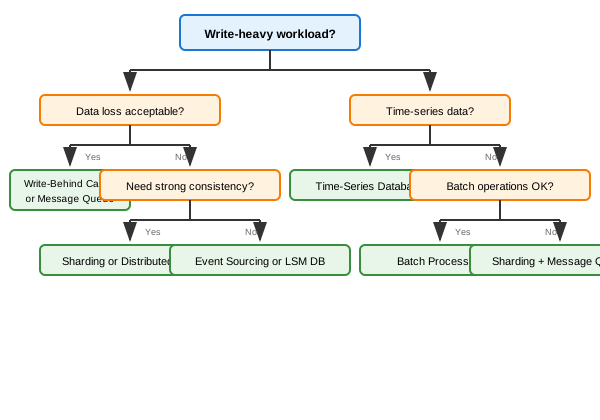
Scaling Writes Architecture Example
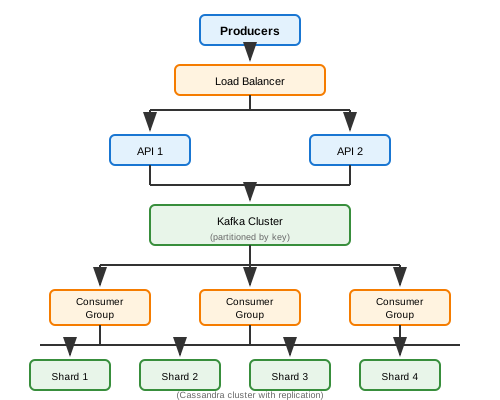
Key Takeaways
- Shard when single DB isn't enough - Most impactful scaling strategy
- Use queues for async writes - Decouple acceptance from processing
- Batch where possible - Dramatically improves throughput
- Choose the right database - LSM for writes, B-tree for reads
- Consider event sourcing - Natural append-only pattern
- Time-series for time-series - Purpose-built is better
- Accept eventual consistency - Often worth the trade-off
- Monitor write amplification - Hidden cost in LSM databases