Multi Step Processes
The Problem
How do you handle operations that span multiple services, databases, or steps where: - Each step can fail independently - The entire process must succeed or be rolled back - Steps may take varying amounts of time - External services may be unreliable
Common Scenarios: - E-commerce order processing (payment → inventory → shipping) - User registration (create account → send email → setup defaults) - Travel booking (flight → hotel → car rental) - Money transfer between banks - Document approval workflows
Options & Trade-offs
1. Two-Phase Commit (2PC)
Philosophy: "All participants agree before committing"
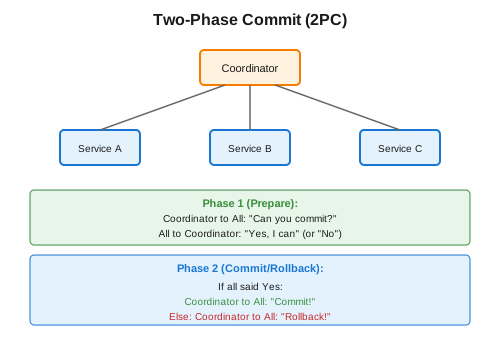
Implementation:
public class TwoPhaseCommitCoordinator {

    public boolean executeTransaction(List<Participant> participants,
                                       TransactionData data) {
        String txId = UUID.randomUUID().toString();

        // Phase 1: Prepare
        boolean allPrepared = true;
        for (Participant p : participants) {
            try {
                if (!p.prepare(txId, data)) {
                    allPrepared = false;
                    break;
                }
            } catch (Exception e) {
                allPrepared = false;
                break;
            }
        }

        // Phase 2: Commit or Rollback
        if (allPrepared) {
            for (Participant p : participants) {
                p.commit(txId);
            }
            return true;
        } else {
            for (Participant p : participants) {
                p.rollback(txId);
            }
            return false;
        }
    }
}
| Pros | Cons |
|---|---|
| Strong consistency (ACID) | Blocking - all wait for slowest |
| Well-understood protocol | Coordinator is SPOF |
| Atomic across participants | Doesn't scale well |
| Network partition = stuck transactions | |
| Latency = sum of all participants |
When to use: - Small number of participants - Same data center (low latency) - Strong consistency absolutely required - Traditional database transactions
2. Saga Pattern
Philosophy: "Execute steps in sequence, compensate on failure"
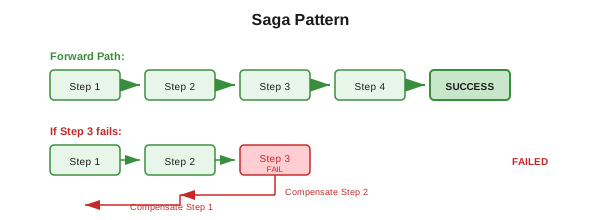
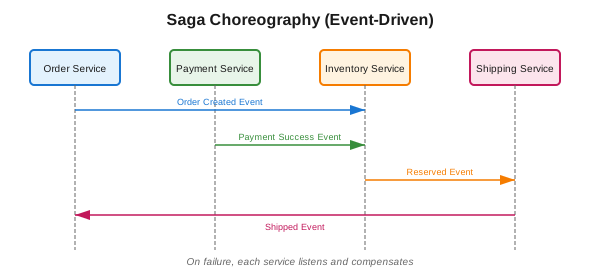
Two Saga Styles:
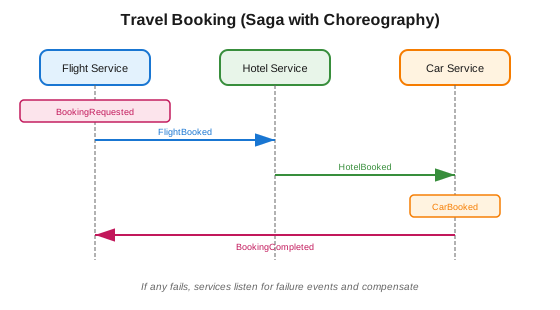
Choreography (Event-Driven)
Orchestration (Centralized)
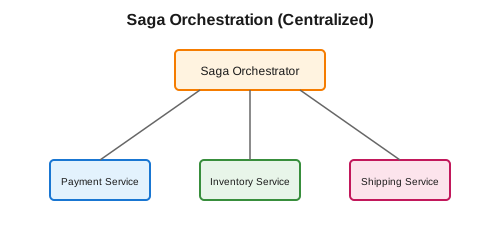
Orchestration Implementation:
public class OrderSaga {

    public enum State {
        STARTED, PAYMENT_COMPLETED, INVENTORY_RESERVED,
        SHIPPING_SCHEDULED, COMPLETED, FAILED
    }

    @Transactional
    public void execute(Order order) {
        SagaContext context = new SagaContext(order);

        try {
            // Step 1: Process Payment
            PaymentResult payment = paymentService.charge(order);
            context.setPaymentId(payment.getId());
            context.setState(State.PAYMENT_COMPLETED);
            saveSagaState(context);

            // Step 2: Reserve Inventory
            ReservationResult reservation = inventoryService.reserve(order);
            context.setReservationId(reservation.getId());
            context.setState(State.INVENTORY_RESERVED);
            saveSagaState(context);

            // Step 3: Schedule Shipping
            ShipmentResult shipment = shippingService.schedule(order);
            context.setShipmentId(shipment.getId());
            context.setState(State.SHIPPING_SCHEDULED);
            saveSagaState(context);

            context.setState(State.COMPLETED);
            saveSagaState(context);

        } catch (Exception e) {
            compensate(context);
            throw new SagaFailedException(e);
        }
    }

    private void compensate(SagaContext context) {
        // Compensate in reverse order
        switch (context.getState()) {
            case SHIPPING_SCHEDULED:
                shippingService.cancel(context.getShipmentId());
                // fall through
            case INVENTORY_RESERVED:
                inventoryService.release(context.getReservationId());
                // fall through
            case PAYMENT_COMPLETED:
                paymentService.refund(context.getPaymentId());
                break;
        }
        context.setState(State.FAILED);
        saveSagaState(context);
    }
}
Saga State Machine:
public class SagaStateMachine {
    private final Map<State, Map<Event, State>> transitions = Map.of(
        State.STARTED, Map.of(
            Event.PAYMENT_SUCCESS, State.PAYMENT_COMPLETED,
            Event.PAYMENT_FAILED, State.COMPENSATING
        ),
        State.PAYMENT_COMPLETED, Map.of(
            Event.INVENTORY_RESERVED, State.INVENTORY_RESERVED,
            Event.INVENTORY_FAILED, State.COMPENSATING
        ),
        // ... more transitions
    );

    public State transition(State current, Event event) {
        return transitions.get(current).get(event);
    }
}
| Choreography | Orchestration |
|---|---|
| Loose coupling | Centralized logic |
| No SPOF | Easier to understand |
| Hard to track overall flow | Single point of failure |
| Complex debugging | Easier testing |
| Good for simple flows | Good for complex flows |
| Pros | Cons |
|---|---|
| No blocking | Eventual consistency only |
| Scales well | Compensations can fail |
| Resilient to failures | Complex error handling |
| Works across services | Harder to debug |
| Async friendly | Temporary inconsistency visible |
When to use: - Microservices architectures - Long-running transactions - Cross-service workflows - When strong consistency isn't required
3. Process Manager / Workflow Engine
Philosophy: "Use a dedicated system to manage complex workflows"
Tools: - Temporal (recommended) - Cadence (Uber) - AWS Step Functions - Camunda - Netflix Conductor
Temporal Example:
// Workflow Definition
@WorkflowInterface
public interface OrderWorkflow {
    @WorkflowMethod
    OrderResult processOrder(Order order);
}

@WorkflowImpl
public class OrderWorkflowImpl implements OrderWorkflow {

    private final PaymentActivity paymentActivity =
        Workflow.newActivityStub(PaymentActivity.class, activityOptions);
    private final InventoryActivity inventoryActivity =
        Workflow.newActivityStub(InventoryActivity.class, activityOptions);

    @Override
    public OrderResult processOrder(Order order) {
        // Temporal handles retries, timeouts, state persistence

        PaymentResult payment = paymentActivity.charge(order);

        try {
            InventoryResult inventory = inventoryActivity.reserve(order);
            ShippingResult shipping = shippingActivity.schedule(order);
            return OrderResult.success(payment, inventory, shipping);

        } catch (Exception e) {
            // Compensation
            paymentActivity.refund(payment.getId());
            throw e;
        }
    }
}

// Activity Definition
@ActivityInterface
public interface PaymentActivity {
    PaymentResult charge(Order order);
    void refund(String paymentId);
}
AWS Step Functions Example:
{
  "StartAt": "ProcessPayment",
  "States": {
    "ProcessPayment": {
      "Type": "Task",
      "Resource": "arn:aws:lambda:payment-function",
      "Next": "ReserveInventory",
      "Catch": [{
        "ErrorEquals": ["PaymentFailed"],
        "Next": "PaymentFailedState"
      }]
    },
    "ReserveInventory": {
      "Type": "Task",
      "Resource": "arn:aws:lambda:inventory-function",
      "Next": "ScheduleShipping",
      "Catch": [{
        "ErrorEquals": ["InventoryFailed"],
        "Next": "RefundPayment"
      }]
    },
    "ScheduleShipping": {
      "Type": "Task",
      "Resource": "arn:aws:lambda:shipping-function",
      "End": true
    },
    "RefundPayment": {
      "Type": "Task",
      "Resource": "arn:aws:lambda:refund-function",
      "Next": "FailState"
    },
    "FailState": {
      "Type": "Fail",
      "Error": "OrderProcessingFailed"
    }
  }
}
| Pros | Cons |
|---|---|
| Built-in retries & timeouts | Additional infrastructure |
| Visual workflow monitoring | Learning curve |
| State persistence handled | Vendor lock-in possible |
| Easy to modify workflows | Cost (managed services) |
| Audit trail included |
When to use: - Complex multi-step workflows - Long-running processes (hours/days) - Need for visibility and monitoring - Human-in-the-loop processes
4. Event Sourcing + Process Manager
Philosophy: "Store all events, derive state, react to events"
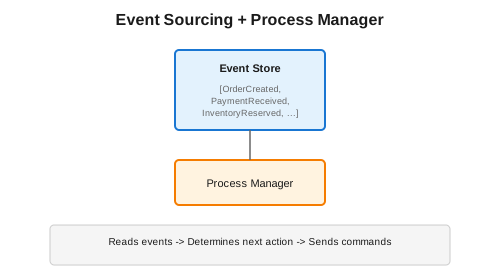
Implementation:
public class OrderProcessManager {

    @EventHandler
    public void on(OrderCreatedEvent event) {
        // Send command to payment service
        commandGateway.send(new ProcessPaymentCommand(
            event.getOrderId(),
            event.getAmount()
        ));
    }

    @EventHandler
    public void on(PaymentSucceededEvent event) {
        // Send command to inventory service
        commandGateway.send(new ReserveInventoryCommand(
            event.getOrderId(),
            event.getItems()
        ));
    }

    @EventHandler
    public void on(InventoryReservedEvent event) {
        commandGateway.send(new ScheduleShippingCommand(
            event.getOrderId()
        ));
    }

    @EventHandler
    public void on(PaymentFailedEvent event) {
        // Mark order as failed
        commandGateway.send(new FailOrderCommand(event.getOrderId()));
    }

    @EventHandler
    public void on(InventoryReservationFailedEvent event) {
        // Compensate: refund payment
        commandGateway.send(new RefundPaymentCommand(event.getOrderId()));
    }
}
| Pros | Cons |
|---|---|
| Complete audit history | Complex to implement |
| Replay/debug capability | Eventual consistency |
| Temporal queries | Storage grows |
| Natural fit for sagas | Learning curve |
When to use: - Audit requirements - Complex domain logic - Need to replay events - CQRS architecture
5. Outbox Pattern (Reliable Messaging)
Philosophy: "Guarantee message delivery alongside database transaction"
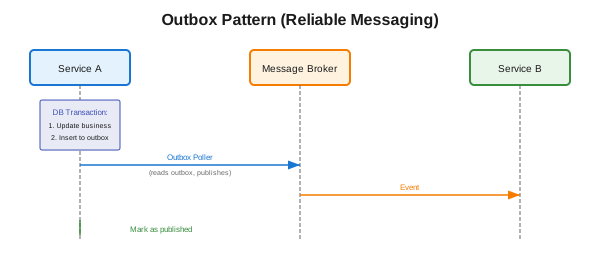
Implementation:
// Within same transaction
@Transactional
public void processOrder(Order order) {
    // 1. Business logic
    orderRepository.save(order);

    // 2. Write to outbox (same transaction)
    OutboxEvent event = new OutboxEvent(
        UUID.randomUUID().toString(),
        "OrderCreated",
        JsonUtils.toJson(new OrderCreatedEvent(order)),
        false
    );
    outboxRepository.save(event);
}

// Separate poller (CDC or polling)
@Scheduled(fixedDelay = 1000)
public void publishOutboxEvents() {
    List<OutboxEvent> events = outboxRepository.findUnpublished();
    for (OutboxEvent event : events) {
        try {
            messagePublisher.publish(event.getTopic(), event.getPayload());
            event.setPublished(true);
            outboxRepository.save(event);
        } catch (Exception e) {
            // Will retry next poll
            log.error("Failed to publish event", e);
        }
    }
}
Using Debezium (CDC):
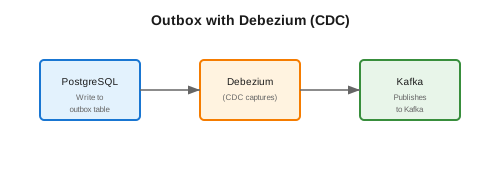
| Pros | Cons |
|---|---|
| Atomic with business logic | Additional table/polling |
| No distributed transaction | Slight delay |
| At-least-once delivery | Need deduplication |
| Simple to implement |
When to use: - Reliable event publishing - When message broker might be down - Avoiding 2PC between DB and broker
6. Transactional Inbox Pattern
Philosophy: "Deduplicate incoming messages reliably"
@Transactional
public void handleEvent(Event event) {
    // Check if already processed
    if (inboxRepository.existsById(event.getId())) {
        log.info("Duplicate event, skipping: {}", event.getId());
        return;
    }

    // Process the event
    processBusinessLogic(event);

    // Mark as processed (same transaction)
    inboxRepository.save(new InboxEntry(event.getId(), Instant.now()));
}
Comparison Matrix
| Approach | Consistency | Complexity | Scalability | Use Case |
|---|---|---|---|---|
| 2PC | Strong | Medium | Poor | Same DC, few services |
| Saga (Choreography) | Eventual | High | Excellent | Simple flows, loose coupling |
| Saga (Orchestration) | Eventual | Medium | Good | Complex flows |
| Workflow Engine | Eventual | Low | Good | Long-running, visibility |
| Event Sourcing | Eventual | High | Excellent | Audit, complex domain |
| Outbox Pattern | At-least-once | Low | Good | Reliable messaging |
Decision Tree
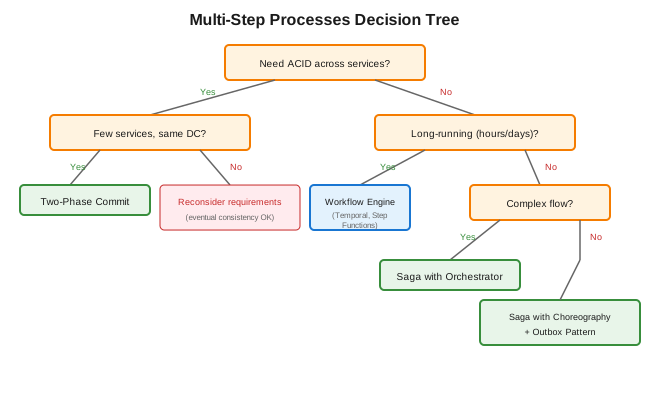
Real-World Examples
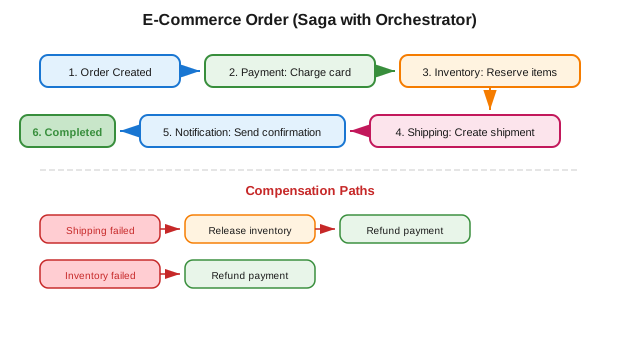
E-Commerce Order (Saga with Orchestrator)
Travel Booking (Saga with Choreography)
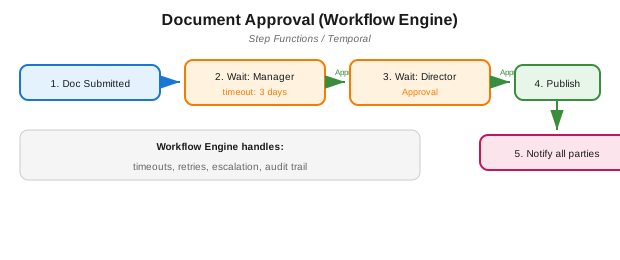
Document Approval (Workflow Engine)
Key Takeaways
- Avoid 2PC in microservices - Use sagas instead
- Prefer orchestration for complex flows - Easier to understand and debug
- Use workflow engines for long-running processes - They handle the hard parts
- Always have compensation logic - Things will fail
- Outbox pattern for reliability - Atomic with business transaction
- Idempotency everywhere - Messages will be duplicated
- Monitor saga states - Know where processes are stuck