Long Running Tasks
The Problem
How do you handle operations that take a long time to complete: - Video transcoding (minutes to hours) - Report generation - Data exports/imports - ML model training - Batch processing - Payment processing with retries - Email campaigns
Challenges: - HTTP timeouts - Client disconnections - Server restarts/crashes - Progress tracking - Resource management - User experience
Options & Trade-offs
1. Async Request-Response Pattern
Philosophy: "Accept request immediately, process in background, notify when complete"
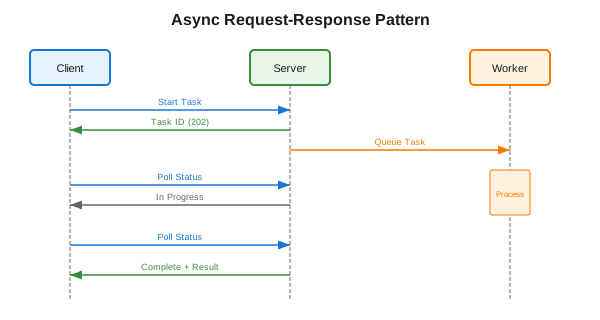
Implementation:
// Controller
@RestController
public class TaskController {

    @PostMapping("/api/reports")
    public ResponseEntity<TaskResponse> generateReport(@RequestBody ReportRequest request) {
        String taskId = UUID.randomUUID().toString();

        // Create task record
        Task task = Task.builder()
            .id(taskId)
            .type("REPORT_GENERATION")
            .status(TaskStatus.PENDING)
            .request(serialize(request))
            .createdAt(Instant.now())
            .build();
        taskRepository.save(task);

        // Queue for async processing
        taskQueue.send(new TaskMessage(taskId, request));

        return ResponseEntity
            .accepted()
            .header("Location", "/api/tasks/" + taskId)
            .body(new TaskResponse(taskId, TaskStatus.PENDING));
    }

    @GetMapping("/api/tasks/{taskId}")
    public ResponseEntity<TaskStatusResponse> getTaskStatus(@PathVariable String taskId) {
        Task task = taskRepository.findById(taskId)
            .orElseThrow(() -> new NotFoundException("Task not found"));

        TaskStatusResponse response = TaskStatusResponse.builder()
            .taskId(taskId)
            .status(task.getStatus())
            .progress(task.getProgress())
            .result(task.getResult())
            .error(task.getError())
            .createdAt(task.getCreatedAt())
            .completedAt(task.getCompletedAt())
            .build();

        if (task.getStatus() == TaskStatus.COMPLETED && task.getResultUrl() != null) {
            response.setResultUrl(task.getResultUrl());
        }

        return ResponseEntity.ok(response);
    }
}

// Worker
@Component
public class ReportWorker {

    @KafkaListener(topics = "report-tasks")
    public void processReport(TaskMessage message) {
        Task task = taskRepository.findById(message.getTaskId())
            .orElseThrow();

        try {
            task.setStatus(TaskStatus.IN_PROGRESS);
            task.setStartedAt(Instant.now());
            taskRepository.save(task);

            // Long-running work with progress updates
            ReportResult result = reportService.generate(
                message.getRequest(),
                progress -> updateProgress(task, progress)
            );

            task.setStatus(TaskStatus.COMPLETED);
            task.setResult(serialize(result));
            task.setResultUrl(result.getDownloadUrl());
            task.setCompletedAt(Instant.now());

        } catch (Exception e) {
            task.setStatus(TaskStatus.FAILED);
            task.setError(e.getMessage());
            task.setCompletedAt(Instant.now());
        }

        taskRepository.save(task);
    }

    private void updateProgress(Task task, int progress) {
        task.setProgress(progress);
        taskRepository.save(task);
    }
}
Client-side Polling:
async function waitForTask(taskId, intervalMs = 2000) {
    while (true) {
        const response = await fetch(`/api/tasks/${taskId}`);
        const task = await response.json();

        updateProgressUI(task.progress);

        if (task.status === 'COMPLETED') {
            return task.result;
        }
        if (task.status === 'FAILED') {
            throw new Error(task.error);
        }

        await delay(intervalMs);
    }
}
| Pros | Cons |
|---|---|
| Simple to implement | Polling overhead |
| Works with any client | Delayed feedback |
| Stateless API | Many status requests |
2. Webhook Callbacks
Philosophy: "Server notifies client when task completes"
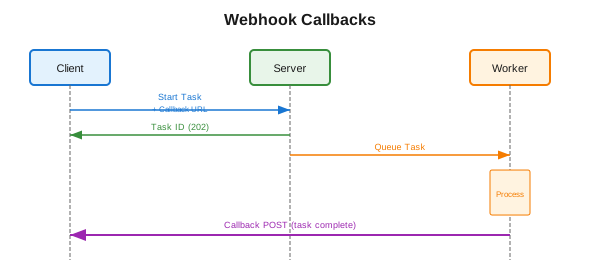
Implementation:
@PostMapping("/api/exports")
public ResponseEntity<TaskResponse> startExport(
        @RequestBody ExportRequest request,
        @RequestHeader("X-Callback-URL") String callbackUrl) {

    String taskId = UUID.randomUUID().toString();

    Task task = Task.builder()
        .id(taskId)
        .type("DATA_EXPORT")
        .status(TaskStatus.PENDING)
        .callbackUrl(callbackUrl)
        .build();
    taskRepository.save(task);

    taskQueue.send(new ExportTaskMessage(taskId, request));

    return ResponseEntity.accepted()
        .body(new TaskResponse(taskId, TaskStatus.PENDING));
}

// Worker sends callback on completion
@Component
public class ExportWorker {

    @KafkaListener(topics = "export-tasks")
    public void processExport(ExportTaskMessage message) {
        Task task = taskRepository.findById(message.getTaskId()).orElseThrow();

        try {
            ExportResult result = exportService.export(message.getRequest());

            task.setStatus(TaskStatus.COMPLETED);
            task.setResult(serialize(result));
            taskRepository.save(task);

            // Send webhook callback
            sendCallback(task.getCallbackUrl(), CallbackPayload.builder()
                .taskId(task.getId())
                .status("COMPLETED")
                .resultUrl(result.getDownloadUrl())
                .build());

        } catch (Exception e) {
            task.setStatus(TaskStatus.FAILED);
            task.setError(e.getMessage());
            taskRepository.save(task);

            sendCallback(task.getCallbackUrl(), CallbackPayload.builder()
                .taskId(task.getId())
                .status("FAILED")
                .error(e.getMessage())
                .build());
        }
    }

    private void sendCallback(String url, CallbackPayload payload) {
        // Retry with exponential backoff
        retryTemplate.execute(context -> {
            restTemplate.postForEntity(url, payload, Void.class);
            return null;
        });
    }
}
| Pros | Cons |
|---|---|
| Real-time notification | Client needs public endpoint |
| No polling overhead | Security concerns (validation) |
| Efficient | Callback failures need handling |
| Firewall issues |
3. Server-Sent Events (SSE)
Philosophy: "Push progress updates to client in real-time"
@GetMapping(value = "/api/tasks/{taskId}/stream",
            produces = MediaType.TEXT_EVENT_STREAM_VALUE)
public SseEmitter streamProgress(@PathVariable String taskId) {
    SseEmitter emitter = new SseEmitter(3600000L); // 1 hour timeout

    // Subscribe to task updates
    taskUpdateSubscriber.subscribe(taskId, update -> {
        try {
            emitter.send(SseEmitter.event()
                .name("progress")
                .data(update));

            if (update.getStatus().isFinal()) {
                emitter.complete();
            }
        } catch (IOException e) {
            emitter.completeWithError(e);
        }
    });

    emitter.onCompletion(() -> taskUpdateSubscriber.unsubscribe(taskId));
    emitter.onTimeout(() -> emitter.complete());

    return emitter;
}
Client:
const eventSource = new EventSource(`/api/tasks/${taskId}/stream`);

eventSource.addEventListener('progress', (event) => {
    const update = JSON.parse(event.data);
    updateProgressBar(update.progress);

    if (update.status === 'COMPLETED') {
        showResult(update.result);
        eventSource.close();
    }
});

eventSource.onerror = (error) => {
    console.error('SSE error:', error);
    eventSource.close();
    // Fallback to polling
    pollForCompletion(taskId);
};
| Pros | Cons |
|---|---|
| Real-time updates | Connection held open |
| No polling needed | Browser connection limits |
| Easy client implementation | Server resource usage |
| Auto-reconnect built in |
4. Workflow Engines
Philosophy: "Use dedicated orchestration for complex long-running processes"
Tools: - Temporal (recommended) - Cadence (Uber) - AWS Step Functions - Apache Airflow - Netflix Conductor
Temporal Example:
// Workflow Interface
@WorkflowInterface
public interface VideoProcessingWorkflow {
    @WorkflowMethod
    VideoResult processVideo(VideoRequest request);

    @QueryMethod
    ProcessingStatus getStatus();

    @SignalMethod
    void cancel();
}

// Workflow Implementation
public class VideoProcessingWorkflowImpl implements VideoProcessingWorkflow {

    private final VideoActivities activities =
        Workflow.newActivityStub(VideoActivities.class, activityOptions);

    private ProcessingStatus status = new ProcessingStatus();

    @Override
    public VideoResult processVideo(VideoRequest request) {
        // Step 1: Download
        status.setStage("DOWNLOADING");
        String localPath = activities.download(request.getSourceUrl());

        // Step 2: Transcode (long running)
        status.setStage("TRANSCODING");
        TranscodeResult transcoded = activities.transcode(localPath, request.getOutputFormats());

        // Step 3: Generate thumbnails
        status.setStage("THUMBNAILS");
        List<String> thumbnails = activities.generateThumbnails(localPath);

        // Step 4: Upload results
        status.setStage("UPLOADING");
        List<String> outputUrls = activities.uploadResults(transcoded.getOutputFiles());

        status.setStage("COMPLETED");
        return new VideoResult(outputUrls, thumbnails);
    }

    @Override
    public ProcessingStatus getStatus() {
        return status;
    }

    @Override
    public void cancel() {
        // Handle cancellation
        Workflow.newDetachedCancellationScope(() -> {
            activities.cleanup();
        });
    }
}

// Activities (the actual work)
@ActivityInterface
public interface VideoActivities {
    @ActivityMethod(startToCloseTimeout = "10m")
    String download(String url);

    @ActivityMethod(startToCloseTimeout = "2h", heartbeatTimeout = "30s")
    TranscodeResult transcode(String path, List<String> formats);

    @ActivityMethod(startToCloseTimeout = "10m")
    List<String> generateThumbnails(String path);

    @ActivityMethod(startToCloseTimeout = "30m")
    List<String> uploadResults(List<String> files);
}

// Starting workflow
@Service
public class VideoService {
    private final WorkflowClient workflowClient;

    public String startProcessing(VideoRequest request) {
        VideoProcessingWorkflow workflow = workflowClient.newWorkflowStub(
            VideoProcessingWorkflow.class,
            WorkflowOptions.newBuilder()
                .setTaskQueue("video-processing")
                .setWorkflowId("video-" + UUID.randomUUID())
                .build()
        );

        // Start async
        WorkflowClient.start(workflow::processVideo, request);

        return workflow.getWorkflowId();
    }

    public ProcessingStatus getStatus(String workflowId) {
        VideoProcessingWorkflow workflow = workflowClient.newWorkflowStub(
            VideoProcessingWorkflow.class, workflowId);
        return workflow.getStatus();
    }
}
| Pros | Cons |
|---|---|
| Handles failures automatically | Infrastructure complexity |
| Built-in retries & timeouts | Learning curve |
| Visual monitoring | Additional service to run |
| State persistence | |
| Versioning support | |
| Timer/sleep support |
5. Job Queues with Priority
Philosophy: "Manage job execution with configurable priority and resources"
public class PriorityJobQueue {

    private final PriorityBlockingQueue<Job> queue = new PriorityBlockingQueue<>(
        100,
        Comparator.comparing(Job::getPriority)
            .thenComparing(Job::getCreatedAt)
    );

    public void submit(Job job) {
        queue.offer(job);
    }

    @Scheduled(fixedDelay = 100)
    public void processJobs() {
        Job job = queue.poll();
        if (job != null) {
            executor.submit(() -> processJob(job));
        }
    }
}

// Using Sidekiq-style approach (Redis-backed)
@Component
public class JobScheduler {
    private final StringRedisTemplate redis;

    public void enqueue(Job job, Priority priority) {
        String queueKey = "jobs:" + priority.name().toLowerCase();
        redis.opsForList().rightPush(queueKey, serialize(job));
    }

    public void enqueueDelayed(Job job, Duration delay) {
        double score = Instant.now().plus(delay).toEpochMilli();
        redis.opsForZSet().add("jobs:scheduled", serialize(job), score);
    }

    // Worker processes from queues in priority order
    @Scheduled(fixedDelay = 100)
    public void processQueues() {
        // Check queues in priority order
        for (String queue : List.of("jobs:critical", "jobs:high", "jobs:default", "jobs:low")) {
            String jobData = redis.opsForList().leftPop(queue);
            if (jobData != null) {
                Job job = deserialize(jobData);
                executor.submit(() -> processWithRetry(job));
                return;
            }
        }
    }

    // Move scheduled jobs to ready queue
    @Scheduled(fixedDelay = 1000)
    public void promoteScheduledJobs() {
        double now = Instant.now().toEpochMilli();
        Set<String> ready = redis.opsForZSet().rangeByScore("jobs:scheduled", 0, now);

        for (String jobData : ready) {
            redis.opsForZSet().remove("jobs:scheduled", jobData);
            redis.opsForList().rightPush("jobs:default", jobData);
        }
    }
}
6. Heartbeating & Liveness
Philosophy: "Detect stuck/dead workers and recover"
@Component
public class HeartbeatWorker {

    @Value("${worker.id}")
    private String workerId;

    private volatile String currentTaskId;

    // Send heartbeat every 10 seconds
    @Scheduled(fixedRate = 10000)
    public void sendHeartbeat() {
        if (currentTaskId != null) {
            redis.opsForValue().set(
                "worker:heartbeat:" + workerId,
                currentTaskId,
                30,
                TimeUnit.SECONDS
            );
        }
    }

    public void processTask(Task task) {
        currentTaskId = task.getId();
        try {
            // Long-running work
            doWork(task);
        } finally {
            currentTaskId = null;
        }
    }
}

// Monitor for dead workers
@Component
public class WorkerMonitor {

    @Scheduled(fixedRate = 60000)
    public void checkWorkers() {
        // Find tasks claimed by workers with expired heartbeats
        List<Task> orphanedTasks = taskRepository.findByStatusAndWorkerHeartbeatBefore(
            TaskStatus.IN_PROGRESS,
            Instant.now().minusSeconds(60)
        );

        for (Task task : orphanedTasks) {
            log.warn("Recovering orphaned task: {}", task.getId());

            if (task.getRetryCount() < task.getMaxRetries()) {
                task.setStatus(TaskStatus.PENDING);
                task.setRetryCount(task.getRetryCount() + 1);
                task.setWorkerId(null);
                taskRepository.save(task);
            } else {
                task.setStatus(TaskStatus.FAILED);
                task.setError("Max retries exceeded after worker failure");
                taskRepository.save(task);
            }
        }
    }
}
7. Checkpointing & Resume
Philosophy: "Save progress so tasks can resume after failure"
public class CheckpointedProcessor {

    public void processLargeDataset(Task task) {
        Checkpoint checkpoint = loadCheckpoint(task.getId());
        long startOffset = checkpoint != null ? checkpoint.getOffset() : 0;

        try (DatasetReader reader = new DatasetReader(task.getDataPath())) {
            reader.seekTo(startOffset);

            int batchSize = 1000;
            List<Record> batch;

            while (!(batch = reader.readBatch(batchSize)).isEmpty()) {
                processBatch(batch);

                // Save checkpoint every batch
                long currentOffset = reader.getOffset();
                saveCheckpoint(task.getId(), new Checkpoint(
                    currentOffset,
                    Instant.now(),
                    computeStats()
                ));
            }
        }

        // Complete
        deleteCheckpoint(task.getId());
    }

    private void saveCheckpoint(String taskId, Checkpoint checkpoint) {
        redis.opsForValue().set(
            "checkpoint:" + taskId,
            serialize(checkpoint),
            Duration.ofDays(7)
        );
    }

    private Checkpoint loadCheckpoint(String taskId) {
        String data = redis.opsForValue().get("checkpoint:" + taskId);
        return data != null ? deserialize(data) : null;
    }
}
8. Resource Management
Philosophy: "Control concurrent execution to prevent overload"
@Configuration
public class ExecutorConfig {

    @Bean
    public ThreadPoolTaskExecutor taskExecutor() {
        ThreadPoolTaskExecutor executor = new ThreadPoolTaskExecutor();
        executor.setCorePoolSize(5);
        executor.setMaxPoolSize(20);
        executor.setQueueCapacity(100);
        executor.setRejectedExecutionHandler(new CallerRunsPolicy());
        executor.setWaitForTasksToCompleteOnShutdown(true);
        executor.setAwaitTerminationSeconds(60);
        return executor;
    }
}

// Semaphore for limiting concurrent heavy tasks
@Component
public class ResourceLimitedProcessor {

    private final Semaphore heavyTaskSemaphore = new Semaphore(3);

    public void processHeavyTask(Task task) {
        try {
            if (!heavyTaskSemaphore.tryAcquire(30, TimeUnit.SECONDS)) {
                throw new ResourceUnavailableException("No capacity for heavy task");
            }

            try {
                doHeavyWork(task);
            } finally {
                heavyTaskSemaphore.release();
            }
        } catch (InterruptedException e) {
            Thread.currentThread().interrupt();
            throw new TaskException("Interrupted waiting for resources", e);
        }
    }
}

// Rate limiting
@Component
public class RateLimitedProcessor {

    private final RateLimiter rateLimiter = RateLimiter.create(10.0); // 10 per second

    public void process(Task task) {
        rateLimiter.acquire();
        doWork(task);
    }
}
Comparison Matrix
| Approach | Complexity | Real-time | Reliability | Best For |
|---|---|---|---|---|
| Async + Polling | Low | No | Medium | Simple tasks |
| Webhooks | Medium | Yes | Medium | B2B integrations |
| SSE | Medium | Yes | Medium | User-facing progress |
| Workflow Engine | High | Yes | High | Complex processes |
| Priority Queues | Medium | No | High | Mixed workloads |
| Checkpointing | Medium | No | High | Data processing |
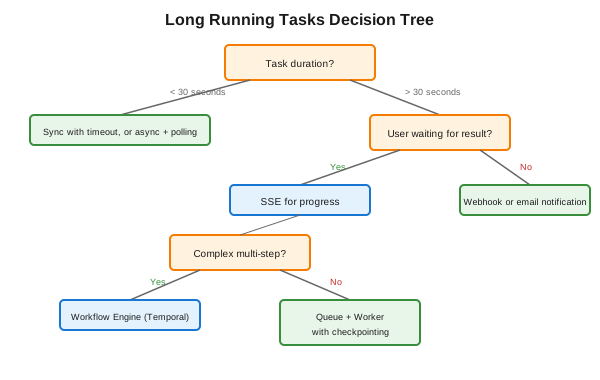
Decision Tree
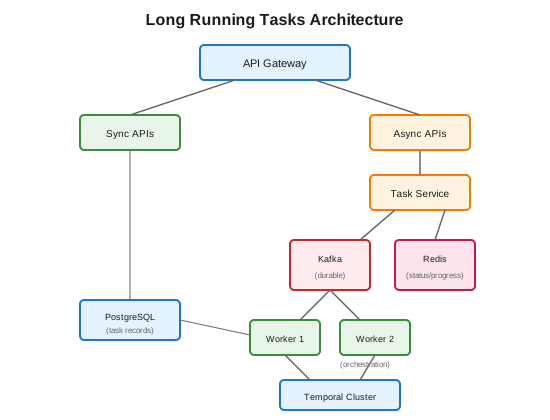
Architecture Example
Key Takeaways
- Never block HTTP requests - Return 202 Accepted immediately
- Persist task state - Survive restarts and failures
- Heartbeat for liveness - Detect and recover from stuck workers
- Checkpoint for resumability - Don't lose progress on failure
- Use workflow engines - For complex multi-step processes
- Provide progress updates - Users need feedback
- Plan for cleanup - Tasks can be cancelled or fail
- Set timeouts everywhere - Tasks shouldn't run forever