API Gateway
What is an API Gateway?
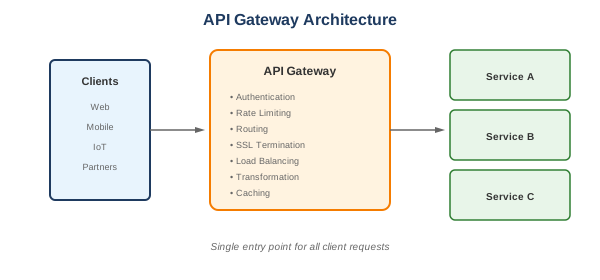
An API Gateway is a server that acts as a single entry point for a set of microservices, handling cross-cutting concerns like authentication, rate limiting, routing, and protocol translation.
Popular Options
| Gateway | Type | Best For |
|---|---|---|
| AWS API Gateway | Managed | AWS ecosystem, serverless |
| Kong | Open Source/Enterprise | Kubernetes, plugins |
| NGINX | Open Source | High performance |
| Envoy | Open Source | Service mesh, Kubernetes |
| Apigee | Enterprise (Google) | API management, analytics |
| Azure API Management | Managed | Azure ecosystem |
| Spring Cloud Gateway | Framework | Spring Boot apps |
| Traefik | Open Source | Docker, Kubernetes |
| Ambassador | Open Source | Kubernetes-native |
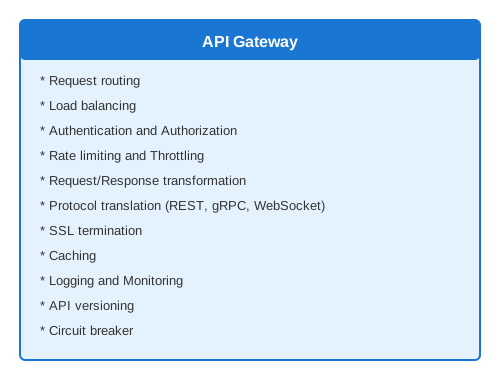
Core Features
Architecture Patterns
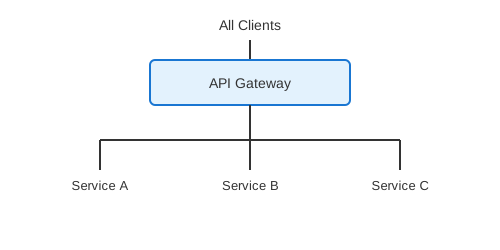
Single Gateway
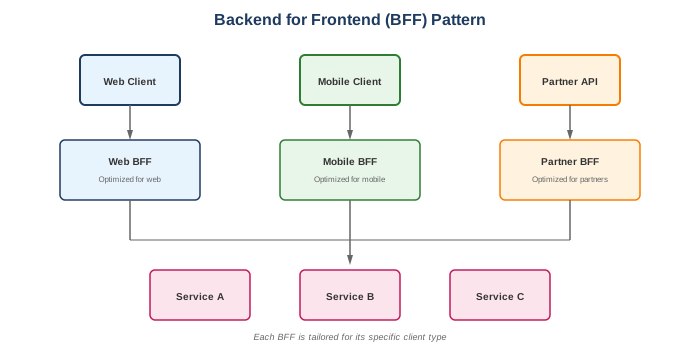
Backend for Frontend (BFF)
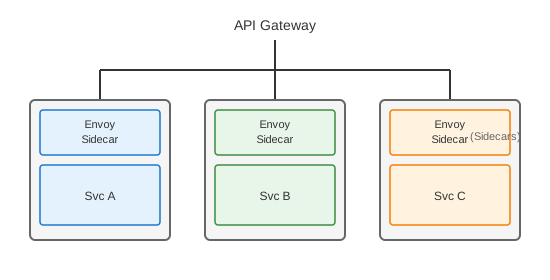
Gateway with Mesh
Common Use Cases
1. Authentication & Authorization
# Kong configuration example
plugins:
  - name: jwt
    config:
      secret_is_base64: false
      claims_to_verify:
        - exp
        - nbf

  - name: acl
    config:
      whitelist:
        - admin
        - user
// Spring Cloud Gateway
@Bean
public RouteLocator customRouteLocator(RouteLocatorBuilder builder) {
    return builder.routes()
        .route("auth_route", r -> r
            .path("/api/**")
            .filters(f -> f
                .filter(new JwtAuthenticationFilter())
                .filter(new RoleAuthorizationFilter("ADMIN")))
            .uri("lb://backend-service"))
        .build();
}
2. Rate Limiting
# Kong rate limiting
plugins:
  - name: rate-limiting
    config:
      minute: 100
      hour: 10000
      policy: local  # or redis for distributed
      fault_tolerant: true
// Spring Cloud Gateway with Redis
@Bean
public RedisRateLimiter redisRateLimiter() {
    return new RedisRateLimiter(10, 20);  // 10 req/sec, burst of 20
}

@Bean
public RouteLocator routes(RouteLocatorBuilder builder) {
    return builder.routes()
        .route("rate_limited", r -> r
            .path("/api/**")
            .filters(f -> f.requestRateLimiter(c -> c
                .setRateLimiter(redisRateLimiter())
                .setKeyResolver(exchange ->
                    Mono.just(exchange.getRequest().getRemoteAddress().getAddress().getHostAddress()))))
            .uri("lb://backend"))
        .build();
}
3. Request Routing
# NGINX configuration
upstream user_service {
    server user-svc-1:8080;
    server user-svc-2:8080;
}

upstream order_service {
    server order-svc-1:8080;
    server order-svc-2:8080;
}

server {
    listen 80;

    location /api/users {
        proxy_pass http://user_service;
    }

    location /api/orders {
        proxy_pass http://order_service;
    }

    # Canary routing
    location /api/v2/users {
        proxy_pass http://user_service_v2;
    }
}
# Kong routing
services:
  - name: user-service
    url: http://user-svc:8080

routes:
  - name: users-route
    service: user-service
    paths:
      - /api/users
    strip_path: false
4. Request/Response Transformation
# Kong request transformer
plugins:
  - name: request-transformer
    config:
      add:
        headers:
          - X-Request-ID:$(uuid)
          - X-Forwarded-Service:user-service
      remove:
        headers:
          - X-Internal-Header
// Spring Cloud Gateway
@Bean
public RouteLocator routes(RouteLocatorBuilder builder) {
    return builder.routes()
        .route("transform", r -> r
            .path("/api/**")
            .filters(f -> f
                .addRequestHeader("X-Request-ID", UUID.randomUUID().toString())
                .removeRequestHeader("X-Internal-Header")
                .modifyResponseBody(String.class, String.class,
                    (exchange, body) -> Mono.just(wrapResponse(body))))
            .uri("lb://backend"))
        .build();
}
5. API Versioning
# Path-based versioning
routes:
  - name: users-v1
    paths: ["/v1/users"]
    service: user-service-v1

  - name: users-v2
    paths: ["/v2/users"]
    service: user-service-v2

# Header-based versioning
  - name: users-v1
    paths: ["/users"]
    headers:
      API-Version: "1"
    service: user-service-v1

  - name: users-v2
    paths: ["/users"]
    headers:
      API-Version: "2"
    service: user-service-v2
6. Circuit Breaker
// Spring Cloud Gateway with Resilience4j
@Bean
public RouteLocator routes(RouteLocatorBuilder builder) {
    return builder.routes()
        .route("circuit_breaker", r -> r
            .path("/api/**")
            .filters(f -> f
                .circuitBreaker(config -> config
                    .setName("backendCircuitBreaker")
                    .setFallbackUri("forward:/fallback")))
            .uri("lb://backend"))
        .build();
}

@RestController
public class FallbackController {
    @GetMapping("/fallback")
    public ResponseEntity<String> fallback() {
        return ResponseEntity.status(HttpStatus.SERVICE_UNAVAILABLE)
            .body("Service temporarily unavailable");
    }
}
# Kong circuit breaker
plugins:
  - name: circuit-breaker
    config:
      threshold: 5
      window_size: 60
      timeout: 30
      half_open_after: 30
7. Caching
# Kong caching
plugins:
  - name: proxy-cache
    config:
      response_code:
        - 200
      request_method:
        - GET
        - HEAD
      content_type:
        - application/json
      cache_ttl: 300
      strategy: memory
# NGINX caching
proxy_cache_path /var/cache/nginx levels=1:2 keys_zone=api_cache:10m
                 max_size=100m inactive=60m use_temp_path=off;

server {
    location /api/ {
        proxy_cache api_cache;
        proxy_cache_valid 200 5m;
        proxy_cache_key "$scheme$request_method$host$request_uri";
        add_header X-Cache-Status $upstream_cache_status;
        proxy_pass http://backend;
    }
}
8. SSL/TLS Termination
server {
    listen 443 ssl http2;
    server_name api.example.com;

    ssl_certificate /etc/ssl/certs/api.crt;
    ssl_certificate_key /etc/ssl/private/api.key;
    ssl_protocols TLSv1.2 TLSv1.3;
    ssl_ciphers ECDHE-ECDSA-AES128-GCM-SHA256:ECDHE-RSA-AES128-GCM-SHA256;
    ssl_prefer_server_ciphers on;

    location / {
        proxy_pass http://backend;  # HTTP to backend
    }
}
AWS API Gateway
REST API
# SAM template
AWSTemplateFormatVersion: '2010-09-09'
Transform: AWS::Serverless-2016-10-31

Resources:
  MyApi:
    Type: AWS::Serverless::Api
    Properties:
      StageName: prod
      Auth:
        DefaultAuthorizer: MyCognitoAuthorizer
        Authorizers:
          MyCognitoAuthorizer:
            UserPoolArn: !GetAtt MyUserPool.Arn

  GetUserFunction:
    Type: AWS::Serverless::Function
    Properties:
      Handler: users.get
      Runtime: nodejs18.x
      Events:
        GetUser:
          Type: Api
          Properties:
            RestApiId: !Ref MyApi
            Path: /users/{id}
            Method: GET
HTTP API (Faster, Cheaper)
Resources:
  HttpApi:
    Type: AWS::Serverless::HttpApi
    Properties:
      StageName: prod
      CorsConfiguration:
        AllowOrigins:
          - "https://example.com"
        AllowMethods:
          - GET
          - POST
Features Comparison
| Feature | REST API | HTTP API |
|---|---|---|
| Latency | Higher | ~60% lower |
| Cost | Higher | ~70% cheaper |
| API Keys | Yes | No |
| Usage Plans | Yes | No |
| Caching | Yes | No |
| Request Validation | Yes | No |
| WAF | Yes | No |
| Private APIs | Yes | Yes |
| Lambda Integration | Yes | Yes |
| JWT Auth | Custom | Native |
Kong Gateway
Docker Compose Setup
version: '3'
services:
  kong-database:
    image: postgres:13
    environment:
      POSTGRES_USER: kong
      POSTGRES_DB: kong
      POSTGRES_PASSWORD: kong

  kong-migration:
    image: kong:latest
    command: kong migrations bootstrap
    environment:
      KONG_DATABASE: postgres
      KONG_PG_HOST: kong-database
      KONG_PG_PASSWORD: kong
    depends_on:
      - kong-database

  kong:
    image: kong:latest
    environment:
      KONG_DATABASE: postgres
      KONG_PG_HOST: kong-database
      KONG_PG_PASSWORD: kong
      KONG_PROXY_ACCESS_LOG: /dev/stdout
      KONG_ADMIN_ACCESS_LOG: /dev/stdout
      KONG_PROXY_ERROR_LOG: /dev/stderr
      KONG_ADMIN_ERROR_LOG: /dev/stderr
      KONG_ADMIN_LISTEN: 0.0.0.0:8001
    ports:
      - "8000:8000"  # Proxy
      - "8001:8001"  # Admin API
    depends_on:
      - kong-migration
Declarative Configuration
# kong.yml
_format_version: "2.1"

services:
  - name: user-service
    url: http://user-svc:8080
    routes:
      - name: users
        paths:
          - /api/users
        strip_path: false
    plugins:
      - name: rate-limiting
        config:
          minute: 100
      - name: jwt
        config:
          secret_is_base64: false

  - name: order-service
    url: http://order-svc:8080
    routes:
      - name: orders
        paths:
          - /api/orders

consumers:
  - username: mobile-app
    plugins:
      - name: rate-limiting
        config:
          minute: 1000
Spring Cloud Gateway
Dependencies
<dependency>
    <groupId>org.springframework.cloud</groupId>
    <artifactId>spring-cloud-starter-gateway</artifactId>
</dependency>
<dependency>
    <groupId>org.springframework.cloud</groupId>
    <artifactId>spring-cloud-starter-netflix-eureka-client</artifactId>
</dependency>
Configuration
# application.yml
spring:
  cloud:
    gateway:
      routes:
        - id: user-service
          uri: lb://user-service
          predicates:
            - Path=/api/users/**
          filters:
            - StripPrefix=1
            - AddRequestHeader=X-Request-ID, ${random.uuid}

        - id: order-service
          uri: lb://order-service
          predicates:
            - Path=/api/orders/**
            - Header=Authorization, Bearer.*
          filters:
            - StripPrefix=1
            - CircuitBreaker=name=orderCircuitBreaker,fallbackUri=forward:/fallback

      default-filters:
        - DedupeResponseHeader=Access-Control-Allow-Origin

      globalcors:
        corsConfigurations:
          '[/**]':
            allowedOrigins: "https://example.com"
            allowedMethods:
              - GET
              - POST
              - PUT
              - DELETE
Custom Filter
@Component
public class AuthenticationFilter implements GatewayFilter, Ordered {

    @Override
    public Mono<Void> filter(ServerWebExchange exchange, GatewayFilterChain chain) {
        ServerHttpRequest request = exchange.getRequest();

        // Check Authorization header
        if (!request.getHeaders().containsKey("Authorization")) {
            return onError(exchange, "No Authorization header", HttpStatus.UNAUTHORIZED);
        }

        String authHeader = request.getHeaders().getFirst("Authorization");
        if (!authHeader.startsWith("Bearer ")) {
            return onError(exchange, "Invalid Authorization header", HttpStatus.UNAUTHORIZED);
        }

        String token = authHeader.substring(7);
        try {
            Claims claims = validateToken(token);

            // Add user info to headers for downstream services
            ServerHttpRequest modifiedRequest = request.mutate()
                .header("X-User-ID", claims.getSubject())
                .header("X-User-Roles", claims.get("roles", String.class))
                .build();

            return chain.filter(exchange.mutate().request(modifiedRequest).build());

        } catch (Exception e) {
            return onError(exchange, "Invalid token", HttpStatus.UNAUTHORIZED);
        }
    }

    private Mono<Void> onError(ServerWebExchange exchange, String message, HttpStatus status) {
        ServerHttpResponse response = exchange.getResponse();
        response.setStatusCode(status);
        return response.setComplete();
    }

    @Override
    public int getOrder() {
        return -100; // Run early in filter chain
    }
}
Trade-offs
| Pros | Cons |
|---|---|
| Single entry point | Single point of failure |
| Cross-cutting concerns centralized | Additional latency |
| Protocol translation | Added complexity |
| Security at the edge | Can become bottleneck |
| Simplified clients | Another component to manage |
| Traffic management | Potential coupling |
Performance Considerations
| Factor | Impact |
|---|---|
| Connection pooling | Critical for backend connections |
| Caching | Reduces backend load |
| Compression | Reduces bandwidth |
| HTTP/2 | Multiplexing, header compression |
| SSL session caching | Reduces handshake overhead |
| Rate limiting | Prevents overload |
| Timeouts | Prevents hanging connections |
When to Use API Gateway
Good For: - Microservices architecture - Multi-client applications (web, mobile, IoT) - Third-party API exposure - Legacy modernization - Cross-cutting concerns
Consider Alternatives When: - Simple monolith (use reverse proxy) - Service mesh already handles concerns - Very latency-sensitive (direct communication) - Simple internal APIs
Best Practices
- Keep it thin - Business logic in services, not gateway
- Avoid single point of failure - Deploy multiple instances
- Cache aggressively - Reduce backend load
- Monitor everything - Latency, errors, throughput
- Rate limit early - Protect backend services
- Use circuit breakers - Fail fast, recover gracefully
- Validate requests - Block bad requests at the edge
- Version APIs - Support multiple versions
- Log requests - For debugging and analytics
- Use async when possible - Non-blocking I/O
Monitoring & Observability
# Kong Prometheus plugin
plugins:
  - name: prometheus
    config:
      status_code_metrics: true
      latency_metrics: true
      bandwidth_metrics: true
      upstream_health_metrics: true
Key Metrics to Monitor: - Request rate - Error rate (4xx, 5xx) - Latency (p50, p95, p99) - Upstream health - Connection pool usage - Rate limit hits - Circuit breaker state - Cache hit ratio